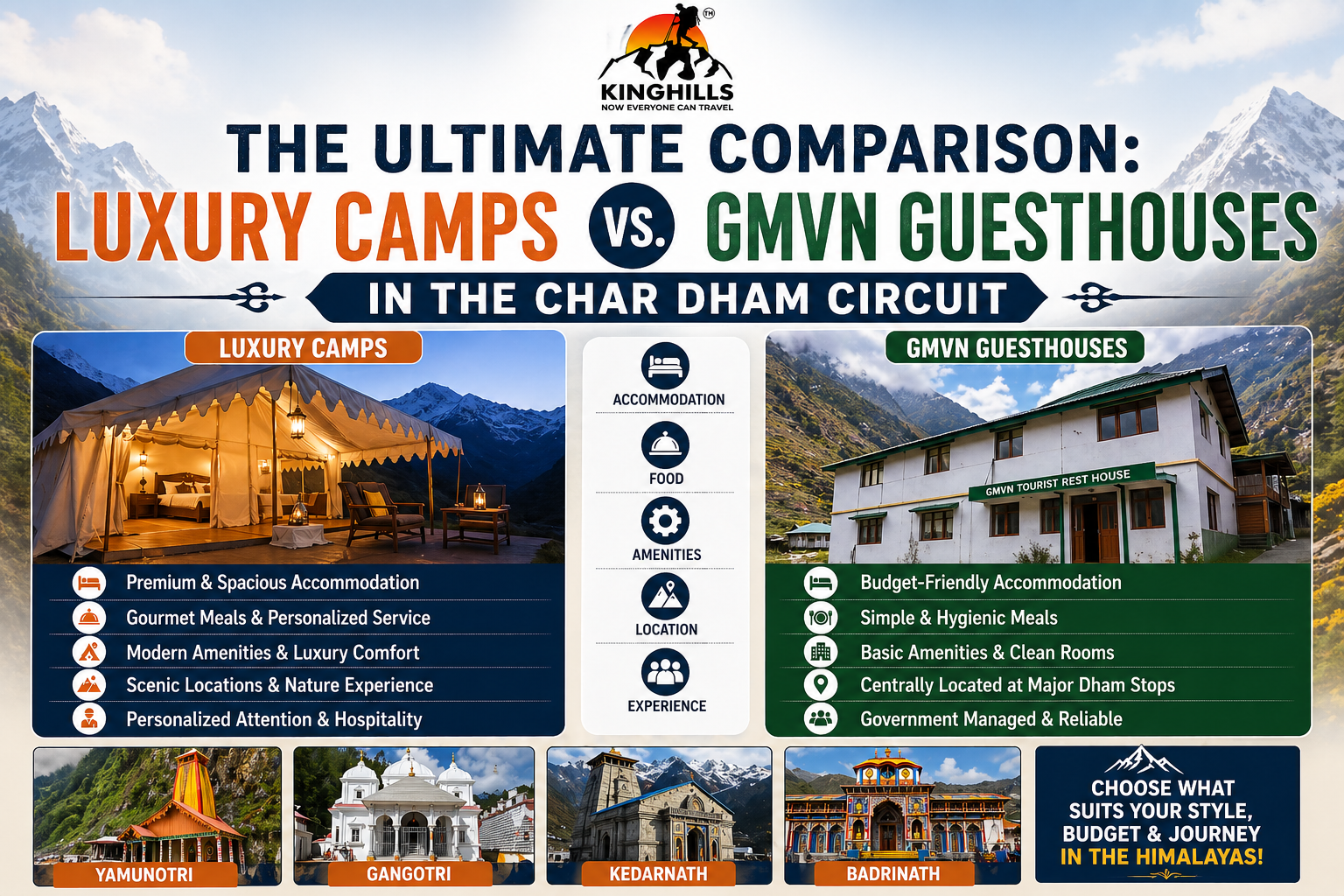
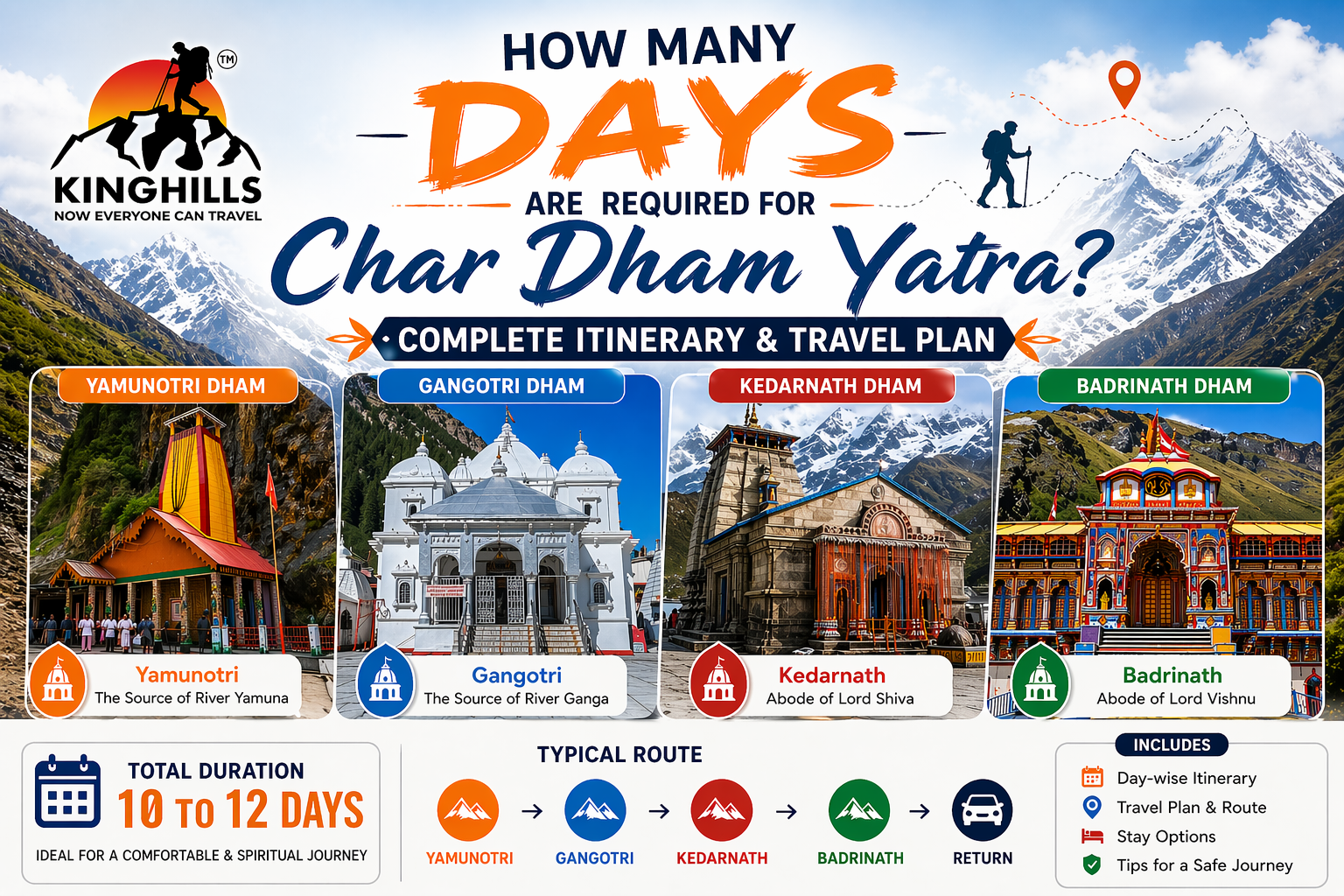
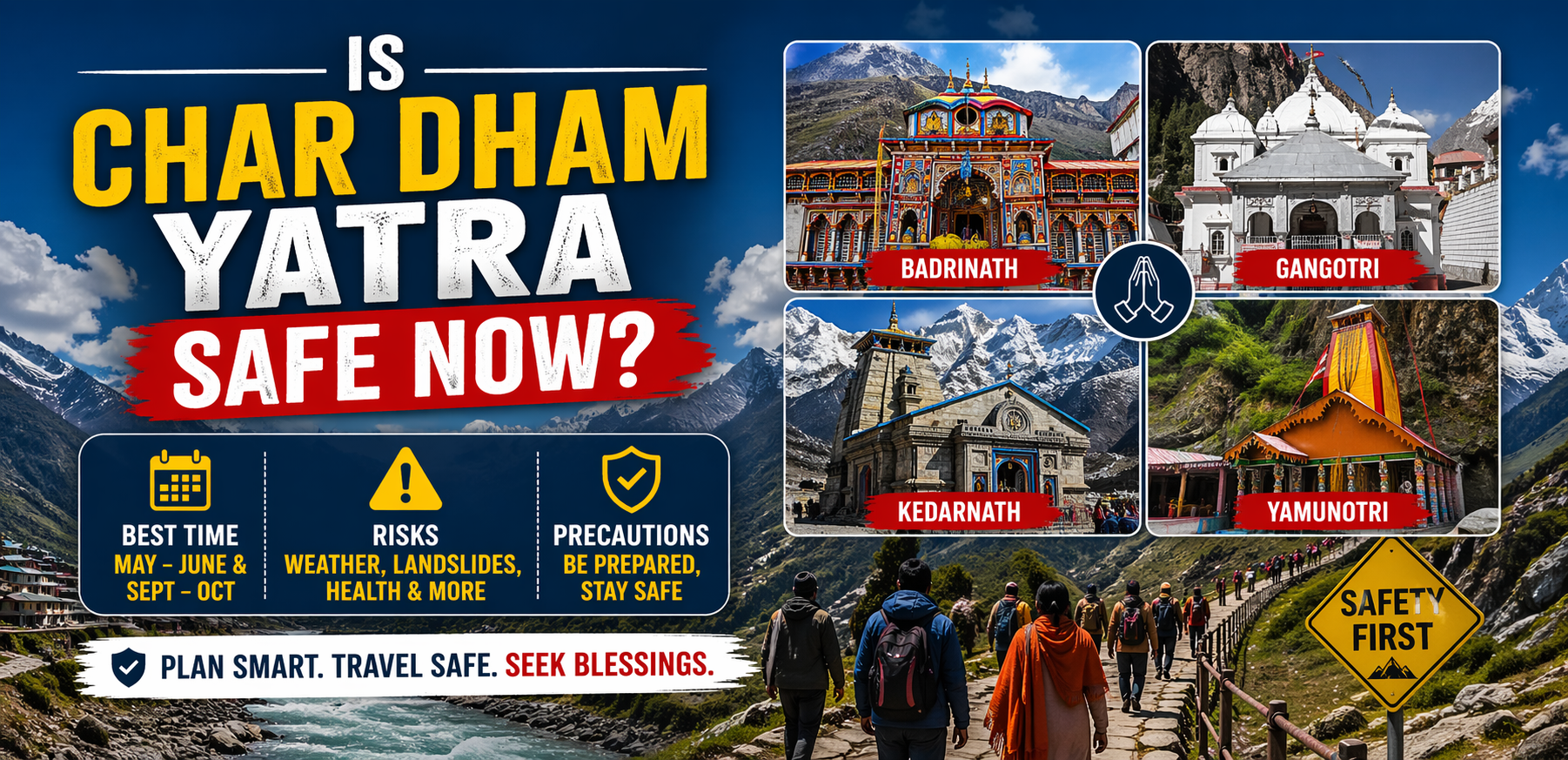
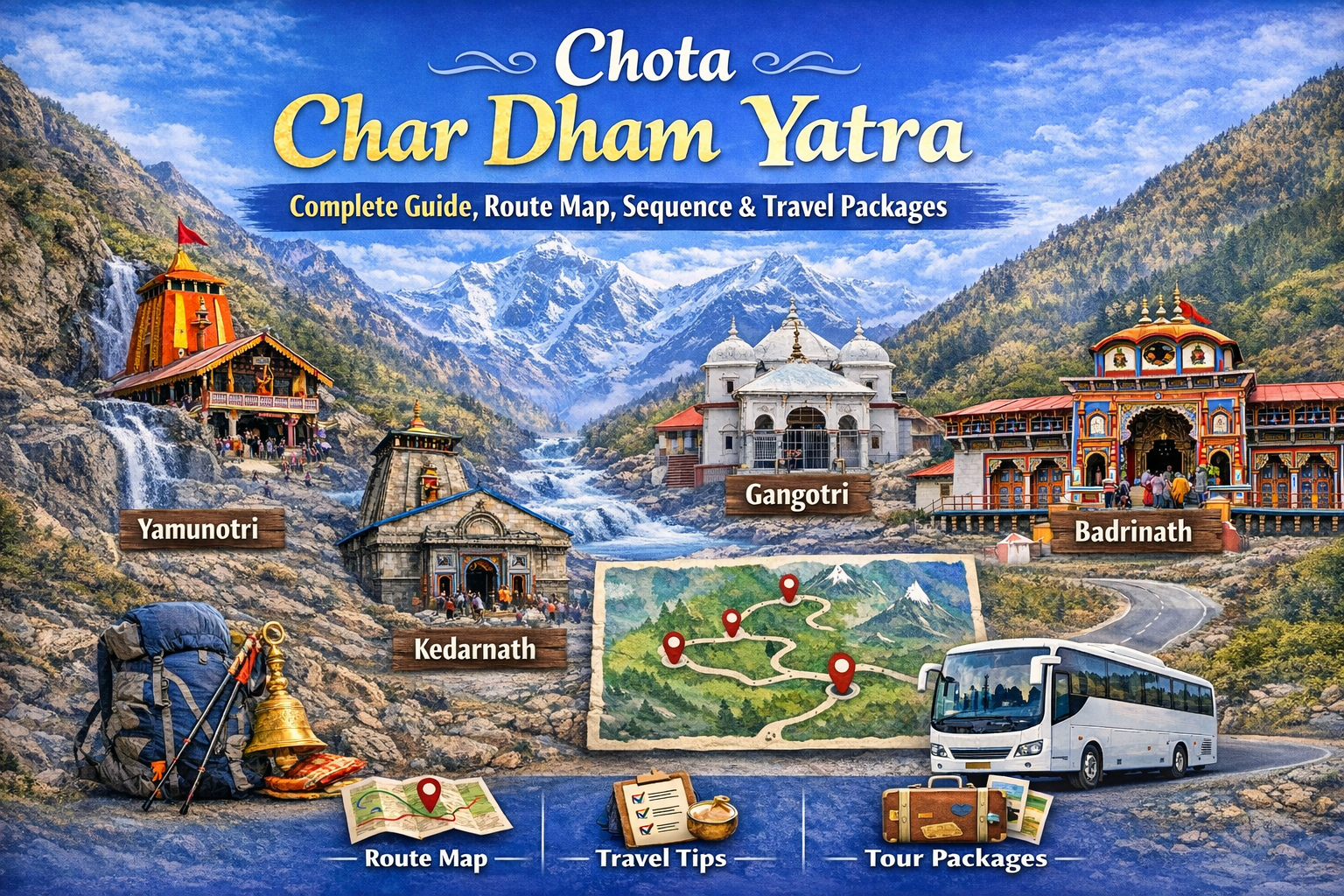
Our Blogs For Char Dham Yatra

Let's explore more of your journey

Our Blog & Latest Articles

Discover travel tips, destination guides, inspiring stories, and expert insights for your next journey.

Explore Blogs

Blog
Char Dham YatraMarch 11, 2026

Importance of Char Dham Yatra: Spiritual Meaning and Sacred Significance

The importance of the Char Dham Yatra has been recognized in Hindu tradition for centuries as one of the most sacred spiritual journeys in India. For millions of devotees, this pilgrimage is not just about visiting temples but about experiencing a deeper connection with faith, spirituality, and divine blessings. Located in the majestic Himalayan region of Uttarakhand, the Char Dham pilgrimage includes four holy shrines that hold immense religious importance in Hinduism.

This sacred journey takes pilgrims to the revered temples of Yamunotri, Gangotri, Kedarnath, and Badrinath. Together, these temples form the spiritual circuit known as the Char Dham. Devotees believe that completing this pilgrimage helps purify the soul and brings spiritual fulfillment. The importance of Char Dham Yatra in the Hindu religion lies in the belief that visiting these sacred shrines washes away sins and helps a person move closer to moksha, which is liberation from the cycle of birth and death.

The Char Dham pilgrimage is also known as a sacred Himalayan pilgrimage because all four temples are located in the serene and spiritually powerful Himalayan mountains. These locations have been places of meditation, devotion, and spiritual practice for thousands of years. Pilgrims often describe the journey as a transformative experience that combines faith, endurance, and spiritual awakening.

Understanding the significance of the Char Dham Yatra requires exploring its mythology, historical background, spiritual meaning, and the beliefs associated with each temple, which is why following a detailed char dham yatra guide becomes essential for every pilgrim. This journey represents one of the most important religious experiences in Hinduism, attracting pilgrims from across India and around the world

Overview of the Four Sacred Shrines

The importance of Char Dham Yatra is closely connected with the four sacred temples that form the pilgrimage circuit. Each of these temples represents a different aspect of divine power and holds unique spiritual significance. The four shrines included in the Char Dham pilgrimage are collectively known as Yamunotri, Gangotri, Kedarnath, and Badrinath. These temples are located in different valleys of Uttarakhand and are surrounded by breathtaking Himalayan landscapes.

Yamunotri is dedicated to Goddess Yamuna, who is worshipped as the goddess of the Yamuna River. Devotees visit this shrine to seek blessings for health, protection, and spiritual purification.

Gangotri is the sacred origin of the River Ganga, one of the holiest rivers in Hindu tradition. Pilgrims believe that the Ganga possesses the divine power to cleanse sins and bring spiritual blessings.

Kedarnath is one of the most sacred shrines dedicated to Lord Shiva and is also one of the twelve Jyotirlingas. The temple represents divine strength, spiritual transformation, and devotion to Lord Shiva.

Badrinath is dedicated to Lord Vishnu and is considered one of the most important temples in Hinduism. It represents preservation, compassion, and divine protection.

Together, these four Char Dham temples create a spiritual journey that symbolizes purification, devotion, divine power, and salvation.

Spiritual Significance of the Char Dham Pilgrimage

The importance of Char Dham Yatra is deeply connected with its spiritual meaning. In Hindu philosophy, pilgrimage is considered a powerful way to purify the mind and soul. Visiting sacred places allows devotees to detach from worldly distractions and focus on spiritual growth. The Char Dham pilgrimage is not just a physical journey but also an inner spiritual journey. Pilgrims travel through mountains, rivers, forests, and valleys while chanting prayers and performing rituals. The natural surroundings of the Himalayas create an atmosphere of peace and spiritual reflection.

The significance of Char Dham Yatra is also associated with devotion and discipline. The journey requires patience, faith, and determination. Many pilgrims undertake the yatra with the belief that the hardships of the journey symbolize the path toward spiritual enlightenment.

Another reason for the importance of Char Dham Yatra in the Hindu religion is the spiritual energy believed to exist in these sacred locations. The temples have been centers of worship and meditation for centuries, making them powerful places of divine presence.

For many devotees, completing the Char Dham pilgrimage becomes one of the most meaningful spiritual experiences of their lives.

Importance of the Yatra for Attaining Moksha

In Hindu belief, the ultimate goal of human life is to achieve moksha and spiritual liberation. Moksha refers to freedom from the cycle of birth, death, and rebirth. The importance of Char Dham Yatra is strongly linked with this concept. Many devotees believe that completing this sacred journey purifies the soul and removes accumulated karma from previous lives.

The pilgrimage is considered a path toward spiritual awakening. By visiting holy temples, performing rituals, and practicing devotion, pilgrims seek divine blessings that guide them toward liberation. The journey also encourages humility and self-reflection. Walking through difficult mountain terrain reminds pilgrims of the impermanence of worldly life and the importance of spiritual growth.

Because of these beliefs, the significance of Char Dham Yatra has remained strong for generations.

Mythological Stories Associated with the Char Dham Temples

Ancient Hindu scriptures contain many fascinating legends that highlight the importance of Char Dham Yatra. The story of Yamunotri is associated with Goddess Yamuna, who is believed to be the daughter of the sun god. Devotees worship her for protection from suffering and to receive blessings of long life. Gangotri is connected with the legend of King Bhagiratha, who performed intense penance to bring the River Ganga from heaven to earth in order to liberate his ancestors. The descent of the Ganga is considered one of the most sacred events in Hindu mythology.

Kedarnath is linked with the story of the Pandavas from the Mahabharata. After the Kurukshetra war, they sought forgiveness from Lord Shiva. Their search led them to the Himalayas, where Shiva revealed himself at Kedarnath. Badrinath is associated with Lord Vishnu, who is believed to have meditated in the region surrounded by the Himalayas.

These ancient legends strengthen the importance of Char Dham Yatra in the Hindu religion and inspire devotees to undertake the sacred journey.

Religious Importance of the Holy Rivers Ganga and Yamuna

The presence of sacred rivers adds another dimension to the importance of Char Dham Yatra. The River Ganga is worshipped as a divine goddess who purifies the soul and washes away sins. Pilgrims visiting Gangotri often perform rituals and take holy dips in the river as an act of spiritual cleansing.

Similarly, the Yamuna River is considered sacred and is associated with devotion, protection, and purity. The connection between these rivers and the pilgrimage highlights the deep spiritual symbolism of water in Hindu tradition.

Pilgrims often perform the following rituals during the yatra:

  • Taking holy baths in sacred rivers

  • Offering prayers and flowers to river deities

  • Performing rituals for ancestors

  • Chanting sacred mantras for purification

These practices strengthen the spiritual experience of the Char Dham pilgrimage.

Significance of Lord Shiva at Kedarnath and Lord Vishnu at Badrinath

Another major reason behind the importance of Char Dham Yatra is the presence of two powerful deities—Lord Shiva and Lord Vishnu.

Kedarnath is dedicated to Lord Shiva, who represents transformation, destruction of negativity, and spiritual awakening. As one of the twelve Jyotirlingas, the temple holds immense spiritual significance. Badrinath, dedicated to Lord Vishnu, represents preservation, protection, and divine compassion.

Together, these temples symbolize balance in the universe. Lord Shiva represents transformation, while Lord Vishnu represents preservation. This divine balance is one of the reasons the significance of Char Dham Yatra is so deeply respected in Hindu tradition.

Historical Background and Role of Adi Shankaracharya

The importance of Char Dham Yatra was further strengthened by the contributions of the great philosopher Adi Shankaracharya.

During ancient times, he traveled across India to revive spiritual traditions and unify different schools of Hindu philosophy. He played a crucial role in promoting pilgrimage routes and encouraging devotion to sacred shrines.

It is believed that he helped restore the Badrinath temple and encouraged devotees to undertake the Himalayan pilgrimage.

His efforts helped establish the Char Dham pilgrimage as one of the most important Hindu pilgrimages in Uttarakhand.

Traditional Pilgrimage Route and Order of Visiting the Four Dhams

The Char Dham pilgrimage follows a traditional order that pilgrims have followed for centuries. The journey usually begins with Yamunotri, where devotees seek blessings from the goddess Yamuna. From there, pilgrims travel to Gangotri to worship the sacred River Ganga. After Gangotri, the journey continues to Kedarnath, where devotees offer prayers to Lord Shiva. The final destination is Badrinath, where pilgrims seek blessings from Lord Vishnu.

This traditional order is considered spiritually significant because it represents the path of purification, devotion, transformation, and salvation. Today many travelers choose organized Char Dham Yatra package options that help them complete the pilgrimage more conveniently while maintaining traditional practices.

Spiritual Benefits and Beliefs Associated with Completing the Yatra

Completing the Char Dham pilgrimage is believed to bring numerous spiritual benefits. Many devotees believe the journey helps cleanse past sins and purify the soul. The pilgrimage also strengthens faith and encourages spiritual discipline.

Some of the commonly believed spiritual benefits include:

  • Purification of the mind and soul

  • Removal of negative karma

  • Spiritual peace and inner balance

  • Divine blessings for family and well-being

  • Progress toward moksha and spiritual liberation

The peaceful Himalayan environment also encourages meditation, prayer, and spiritual reflection. Because of these benefits, the importance of the Char Dham Yatra continues to inspire millions of pilgrims every year.

Why the Char Dham Yatra Continues to Inspire Devotees

Even in modern times, the importance of Char Dham Yatra remains strong among devotees. Many pilgrims undertake the journey to reconnect with their faith and seek blessings for their families. Others see the pilgrimage as an opportunity to experience the spiritual beauty of the Himalayas. The journey also allows people to disconnect from daily routines and focus on devotion and self-discovery.

The combination of spirituality, mythology, history, and breathtaking natural beauty makes this sacred Himalayan pilgrimage one of the most meaningful religious experiences in India.

Conclusion

The importance of Char Dham Yatra goes far beyond visiting sacred temples. It represents a spiritual journey that connects devotees with divine energy, ancient traditions, and the majestic Himalayan landscape.

From the mythological stories of holy rivers and divine deities to the historical contributions of spiritual teachers, the significance of Char Dham Yatra reflects centuries of faith and devotion.

For millions of pilgrims, completing this sacred journey symbolizes spiritual purification, inner transformation, and a step closer to moksha and spiritual liberation.

The timeless spiritual power of this Hindu pilgrimage in Uttarakhand continues to inspire generations of devotees to embark on this sacred path of faith and devotion.

Frequently Asked Questions for the Importance of Char Dham Yatra

1. Why is Char Dham Yatra important in the Hindu religion?

The Char Dham Yatra is considered one of the most sacred pilgrimages in Hinduism. It involves visiting four holy temples in the Himalayas: Yamunotri, Gangotri, Kedarnath, and Badrinath. Devotees believe that completing this spiritual journey helps purify the soul, remove past sins, and bring them closer to divine blessings.

2. What is the significance of Char Dham Yatra?

The significance of the Char Dham Yatra lies in its deep spiritual and religious value. The pilgrimage connects devotees with important Hindu deities and sacred rivers. It is believed that visiting all four dhams brings spiritual purification, inner peace, and spiritual growth.

3. Which temples are included in the Char Dham Yatra?

The Char Dham Yatra includes four sacred temples located in Uttarakhand:

  • Yamunotri Temple is dedicated to the Goddess Yamuna

  • Gangotri Temple is dedicated to the Goddess Ganga

  • Kedarnath Temple is dedicated to Lord Shiva

  • Badrinath Temple is dedicated to Lord Vishnu

These temples together form one of the most important pilgrimage circuits in Hinduism.

4. What is the spiritual meaning of the Char Dham pilgrimage?

The Char Dham pilgrimage symbolizes a spiritual journey toward self-purification and devotion. Each dham represents a step in spiritual awakening, where devotees seek divine blessings, reflect on their faith, and strengthen their connection with God.

5. How does Char Dham Yatra help in achieving moksha?

In Hindu belief, completing the Char Dham Yatra is considered a path toward moksha, or liberation from the cycle of birth and death. Devotees believe that sincere prayer and devotion during the pilgrimage cleanse past karmas and help the soul move closer to spiritual liberation.

6. Why are Yamunotri, Gangotri, Kedarnath, and Badrinath considered sacred?

These four dhams are considered sacred because they are associated with important Hindu deities, ancient legends, and holy rivers. Yamunotri and Gangotri mark the origins of the Yamuna and Ganga rivers, while Kedarnath and Badrinath are among the most revered temples dedicated to Lord Shiva and Lord Vishnu.

7. What is the religious history behind the Char Dham temples?

The Char Dham temples have deep roots in Hindu religious history and mythology. According to tradition, these temples were revived and popularized as a pilgrimage circuit by the philosopher Adi Shankaracharya in the 8th century. Since then, millions of devotees have undertaken this sacred journey to seek divine blessings.

8. Why is Char Dham considered a sacred Himalayan pilgrimage?

Char Dham is located in the Himalayan region of Uttarakhand, which has long been regarded as a spiritually powerful and sacred landscape in Hindu tradition. The mountains, rivers, and ancient temples create a spiritual environment where devotees feel closer to nature and the divine.

9. Who started the Char Dham Yatra tradition in Hinduism?

The Char Dham Yatra tradition is widely believed to have been organized and promoted by the philosopher and saint Adi Shankaracharya during the 8th century. He established temples and pilgrimage routes to encourage spiritual unity and devotion among Hindus.

10. What are the spiritual benefits of doing the Char Dham Yatra?

The Char Dham Yatra offers many spiritual benefits, including inner peace, devotion, and spiritual purification. Devotees believe that visiting these sacred temples strengthens faith, deepens spiritual understanding, and provides blessings for a peaceful and meaningful life.

Read Full Story
Blog
Char Dham YatraMarch 8, 2026

Char Dham Yatra Package Cost: Budget Breakdown & Package Pricing

For many pilgrims, planning the Char Dham Yatra is a spiritual goal, but understanding the actual cost involved is just as important as choosing the right dates or route. In 2026, with rising travel expenses, changing regulations, and multiple travel options available, pilgrims often feel confused about package pricing and what they are truly paying for.

This guide explains the cost of Char Dham Yatra Package in a clear, practical way. Instead of vague price ranges, it breaks down budget categories, explains what different packages include, highlights possible hidden expenses, and helps pilgrims decide whether booking through an agent makes sense for their journey.

Understanding How Char Dham Yatra Package Pricing Works

The cost of a Char Dham Yatra package is not fixed. It depends on several factors such as travel duration, accommodation type, transport mode, group size, and season. A shorter itinerary with basic hotels will naturally cost less than a slower-paced journey with premium stays and assisted travel.

Package pricing usually reflects:

  • Number of travel days

  • Type of transport used

  • Category of accommodation

  • Group or private travel style

  • Time of travel during the season

Understanding these elements helps pilgrims compare packages more realistically.

Char Dham Yatra Package Cost 2026 Explained

In 2026, most chardham package costs fall into three broad categories: budget, standard, and luxury. Each category serves a different type of pilgrim and travel expectation.

Budget-oriented packages focus on essentials and basic comfort, while higher-priced packages emphasize convenience, comfort, and reduced physical strain. The key is choosing a package that matches your health, travel pace, and expectations rather than only looking at the lowest price.

Char Dham Yatra Budget Planning Guide

Budget planning is ideal for pilgrims who are physically fit, flexible with comfort, and willing to travel at a faster pace. These packages usually focus on covering all four dhams efficiently.

What budget packages usually include?

  • Shared transport

  • Basic guesthouses or standard hotels

  • Fixed itinerary with limited customization

  • Simple vegetarian meals

Which budget packages suit best?

  • First-time pilgrims on a limited budget

  • Younger travelers

  • Groups comfortable with shared travel

Budget planning requires realistic expectations, as travel days may be long and accommodations simple.

Standard Char Dham Yatra Packages: Balanced Comfort & Cost

Standard packages are the most popular choice for families and mixed-age groups. They aim to balance cost, comfort, and pacing.

Typical inclusions

  • Comfortable hotels (mid-range category)

  • Dedicated vehicle for the group

  • Balanced itinerary with rest days

  • Assistance with permits and logistics

These packages offer better acclimatization and less fatigue compared to budget options, making them suitable for a wider range of pilgrims.

Luxury Char Dham Yatra Packages: What’s Included?

The luxury packages for char dham yatra are designed for pilgrims who prioritize comfort, health, safety, and time efficiency. They are especially popular among senior citizens and those with limited travel time

What luxury packages usually offer

  • Premium hotels or best-available stays

  • Slower-paced itineraries

  • Minimal physical strain

  • Priority planning and personalized support

Luxury packages reduce stress and fatigue, allowing pilgrims to focus more on darshan and spiritual experience rather than travel challenges.

How Travel Duration Affects Package Cost

One of the biggest cost influencers is the number of travel days. Shorter itineraries often cost more per day due to tighter scheduling, while longer itineraries spread costs but add accommodation and meal expenses.

A relaxed itinerary:

  • Improves acclimatization

  • Reduces health risks

  • Slightly increases the total cost

Pilgrims should avoid rushing the journey just to reduce expenses, as this often leads to discomfort.

Transport Type and Its Impact on Pricing

Transport plays a major role in the overall cost.

Common transport options

  • Shared vehicles for group tours

  • Private vehicles for families

  • Assisted travel options for specific routes

More personalized transport increases cost but significantly improves comfort, especially for elderly pilgrims.

Hidden Costs to Expect During Char Dham Yatra

Many pilgrims underestimate additional expenses not always highlighted in package pricing.

Common hidden or extra costs

  • Pony or palanquin charges for trekking routes

  • Extra meals outside the package plan

  • Medical emergencies or medicines

  • Tips and local assistance charges

  • Weather-related itinerary changes

Factoring in these expenses helps avoid surprises during the journey.

Seasonal Impact on Char Dham Yatra Package Cost

Package pricing fluctuates depending on the month of travel.

General seasonal trends

  • Early season: Slightly higher costs due to limited availability

  • Peak season: Highest prices due to demand

  • Post-monsoon: Balanced pricing with better availability

Choosing the right travel window can significantly affect your overall budget.

Is Char Dham Yatra Worth Booking Through an Agent?

This is one of the most common questions pilgrims ask. While independent planning may seem cheaper initially, many pilgrims find that travel agents for chardham add value by managing logistics, registrations, accommodation availability, and route challenges.

Booking through an agent can be worthwhile if:

  • You are traveling for the first time

  • Senior citizens are part of the group

  • You want a structured itinerary

  • You prefer assistance during disruptions

The travel agencies & agents reduce uncertainty, which is often worth the additional cost.

How to Compare Char Dham Yatra Packages Smartly

Instead of comparing prices alone, pilgrims should evaluate:

  • Day-wise itinerary quality

  • Accommodation location and category

  • Support during emergencies

  • Flexibility in case of weather delays

A slightly higher-priced package often delivers better overall value.

Common Budgeting Mistakes Pilgrims Make

Pilgrims should avoid:

  • Choosing the cheapest option without checking inclusions

  • Ignoring hidden costs

  • Rushing the itinerary to save money

  • Underestimating health-related expenses

Awareness helps prevent discomfort and overspending later.

Final Thoughts on Char Dham Yatra Package Cost 2026

The Char Dham Yatra is not about spending more or less; it is about planning wisely. Understanding package costs, knowing what is included, and preparing for additional expenses allows pilgrims to choose an option that aligns with both budget and comfort.

In 2026, pilgrims who plan early, compare thoughtfully, and prioritize safety and pacing will find that the right package transforms the journey into a peaceful and spiritually rewarding experience. When costs are understood clearly, devotion remains the focus, not financial surprises.

Frequently Asked Questions for Char Dham Yatra Package Cost

1. How much does the Char Dham Yatra package cost per person?

The Char Dham Yatra package cost per person usually ranges from INR 30,000 to INR 80,000 for road tours, depending on accommodation type, travel city, and inclusions. Luxury and helicopter packages cost more.

2. What is included in the Char Dham Yatra package pricing?

Most packages include transportation, hotel accommodation, meals as per the itinerary, sightseeing, and temple visit assistance. Some packages may also include permits and basic travel support.

3. What is the average cost of Char Dham Yatra from Haridwar or Delhi?

The average cost from Haridwar or Delhi generally falls between INR 35,000 and INR 70,000 per person for standard group tours, depending on hotel category and travel season.

4. Why do Char Dham Yatra package prices vary so much?

Prices vary due to hotel quality, group size, transport type, travel duration, season demand, and additional services such as VIP darshan or helicopter options.

5. What is the cost difference between the standard and luxury Char Dham Yatra package?

Standard packages focus on budget stays and shared travel, while luxury packages include premium hotels, better vehicles, and personalized services. Luxury tours can cost two to three times more than standard packages.

6. Are there any hidden costs in Char Dham Yatra packages?

Some expenses like pony or palki charges, helicopter tickets, personal expenses, entry tickets, and special darshan fees may not be included. Always check the inclusions and exclusions before booking.

7. How much does a luxury Char Dham Yatra package cost in India?

A luxury Char Dham Yatra package in India typically costs between INR 90,000 and INR 1,80,000 per person by road, while helicopter luxury tours can exceed INR 2 lakh per person.

8. Is booking through a Char Dham Yatra agent cheaper than online packages?

Booking through a reliable travel agent can sometimes offer better customization and support, while online packages may provide fixed pricing and seasonal discounts. The best option depends on traveler preferences.

9. What is the cheapest way to do the Char Dham Yatra?

The cheapest way is traveling in a group tour, choosing budget accommodations, booking early, and traveling during shoulder season months instead of peak dates.

10. When is the best time to book the Char Dham Yatra package for a lower price?

Booking 3 to 6 months in advance usually gives better prices. Early bookings before peak season departures often offer lower rates and better availability.

Read Full Story
Blog
Char Dham YatraMarch 7, 2026

Char Dham Yatra Dates 2026: Opening & Closing Dates, Season-Wise Travel Guide

Understanding the right time to travel plays a crucial role in planning a successful Char Dham Yatra. Each year, as the temple doors open for pilgrims, devotees begin their sacred journey to the four holy shrines—Yamunotri Temple, Gangotri Temple, Kedarnath Temple, and Badrinath Temple, nestled in the Himalayas of Uttarakhand. To make the pilgrimage more structured and hassle-free, many travelers opt for a thoughtfully designed Char Dham Yatra package. This not only helps in managing travel arrangements efficiently but also allows pilgrims to fully immerse themselves in the spiritual significance of the journey without unnecessary stress.


The Char Dham Yatra 2026 opening dates are of prime importance, as the temples are open for only six months in a year due to heavy snowfall in the Uttarakhand region during the winter months. This comprehensive Char Dham Yatra guide will help you understand the opening dates, closing dates, travel information during different seasons, and planning tips.

Char Dham Yatra 2026 Opening & Closing Dates

The dates of the Char Dham Yatra are one of the most crucial points to keep in mind while planning your Char Dham Yatra. The fact that all four shrines are situated in the high Himalayan regions means that they are accessible for only a limited period every year. 


The Char Dham Yatra usually takes place from April or May to October, depending on the weather and the decisions of the temple management. Snowfall during the winter months makes it impossible to access the shrines, and this is why the opening and closing dates are strictly adhered to.


Knowing the Char Dham Yatra 2026 dates will enable you to plan your Char Dham Yatra in the best possible manner, depending on the weather, the number of devotees, and the road conditions. The best time to visit is during the early season, when the weather is pleasant, or during the post-monsoon season, when you can have a peaceful darshan. The monsoon season is avoided because of landslides and heavy rainfall in the mountainous regions.


The tentative dates for the opening and closing of the Char Dham Yatra 2026 are as follows and are yet to be confirmed by the temple management:


Dham

Opening Date (2026)

Closing Date (2026)

Yamunotri Temple

19 April 2026 (Tentative)

23 October 2026 (Tentative)

Gangotri Temple

19 April 2026 (Tentative)

23 October 2026 (Tentative)

Kedarnath Temple

22 April 2026 (Tentative)

23 October 2026 (Tentative)

Badrinath Temple

24 April 2026 (Tentative)

23 October 2026 (Tentative)

Important Notes About Char Dham Yatra 2026 Dates

  • Dates are announced officially on religious occasions such as Maha Shivratri or Basant Panchami.

  • The temples open around Akshaya Tritiya each year.

  • Closing usually occurs around Dussehra, Diwali, or Bhai Dooj.

  • Advance booking of hotels and Char Dham Yatra registration is highly recommended.

Keeping track of the official Char Dham Yatra 2026 opening and closing dates ensures you plan your pilgrimage safely within the authorized travel window and enjoy a smooth spiritual journey. 

Chardham Season-Wise Guide As Per Tentative 2026 Dates

With the tentative dates of the Char Dham Yatra 2026 starting from 19 April 2026 and ending on 23 October 2026, it is very important to choose the correct time for traveling. Since the temples are open in mid to late April and closed before the snowfall in late October, the devotees have a fixed time period to perform the Yatra.


The weather in the Himalayas changes suddenly, and thus visiting the place as per the season ensures a safe and smooth darshan experience. The following are the details of the seasons mentioned above, as per the tentative dates.

1. Opening & Early Season (Mid-April to June 2026)

This season starts right after the opening of the temples – roughly from 19 April 2026 for Yamunotri and Gangotri, 22 April for Kedarnath, and 24 April for Badrinath (provisional). The months of May and June are peak season months, as the weather is pleasant and schools are on summer holidays.


The climate is characterized by temperatures between 5°C and 20°C, with well-maintained roads.

Advantages:

  • Fresh temple opening atmosphere

  • Pleasant weather and stable road conditions

  • Ideal for family pilgrimages

  • Full accessibility to all dhams

Challenges:

  • Heavy rush during May–June

  • Long waiting hours for darshan

  • Higher hotel and helicopter package prices

Advance booking is highly recommended during this period.

2. Monsoon Season (July to August 2026)

Though the temples are open in July and August within the Char Dham Yatra dates 2026, one has to be careful while traveling during the monsoon season. The state of Uttarakhand receives moderate to heavy rainfall, which makes landslides a possibility.

Advantages:

  • Fewer crowds

  • Scenic greenery and fresh landscapes

  • Easier hotel availability

Risks:

  • Landslides and road closures

  • Travel delays

  • Slippery trekking routes

Pilgrims are generally advised to avoid monsoon travel unless necessary and to monitor weather advisories carefully.

3. Post-Monsoon & Closing Season (September to 23 October 2026)

This is believed to be the best period in the Char Dham Yatra 2026 opening and closing dates. The skies are clearer, and the climate is cooler, making September and early October the best time for peaceful darshan before the temples close on about 23 October 2026 (tentative).


The number of people is significantly lower compared to May-June, and the roads are also better due to monsoon repairs.

Advantages:

  • Clear Himalayan views

  • Comfortable weather

  • Shorter darshan queues

  • Ideal for senior citizens

This period is perfect for pilgrims seeking a calm and spiritually immersive experience.

Char Dham Yatra Registration 2026

For the Char Dham Yatra of 2026, the registration process is compulsory for all devotees. The registration process assists in crowd management and safety monitoring.


In case the registration is not valid, it may not be possible to enter the temples.

Registration Process:

  • Online registration through the official portal

  • Offline counters in Haridwar, Rishikesh, and key entry points

  • Biometric verification during the journey

Documents Required:

  • Valid government-issued ID

  • Mobile number

  • Travel schedule details

It is advisable to complete registration immediately after confirming your travel dates.

Char Dham Yatra 2026 Dates and Itinerary Planning From Haridwar

If you plan your Char Dham Yatra journey as per the Char Dham Yatra 2026 dates, it will be a smooth and pious experience. Since the temples are expected to open from 19 April 2026 to 23 October 2026, one needs to plan their journey accordingly. This will help them have enough time to rest and acclimate to the high altitude, along with visiting the temples on time.

Here is a detailed Char Dham Yatra Itinerary from Haridwar, visiting Yamunotri, Gangotri, Kedarnath, and Badrinath in the clockwise direction.

Day 1: Haridwar – Barkot

Your journey begins with pickup from Haridwar in the early morning. Drive towards Barkot, a scenic town located on the banks of the Yamuna River. The route offers beautiful Himalayan landscapes and gradual altitude gain.

  • Pickup from Haridwar

  • Drive to Barkot

  • Hotel check-in & leisure time

  • Dinner & overnight stay at Barkot

Day 2: Barkot – Yamunotri – Barkot

Start early around 4:00 AM and drive to Janki Chatti (approx. 42 km). From there, begin the 5 km trek to Yamunotri Temple. Pilgrims may walk or hire a pony/doli at their own cost.

  • Holy dip in Jamnabai Kund (hot spring)

  • Temple darshan at Yamunotri

  • Trek back to Janki Chatti

  • Return to Barkot

  • Dinner & overnight stay

Day 3: Barkot – Uttarkashi (95 km approx.)

After breakfast, drive to Uttarkashi, a prominent spiritual town along the Bhagirathi River. En route, visit Prakateshwar Mahadev Temple. Upon arrival, visit Kashi Vishwanath Temple before checking into the hotel.

  • Drive to Uttarkashi

  • Visit Prakateshwar Mahadev

  • Darshan at Kashi Vishwanath Temple

  • Dinner & overnight stay

Day 4: Uttarkashi – Gangotri – Uttarkashi (100 km each side)

Depart early (4:00–5:00 AM) for Gangotri Temple. Take a holy dip in the Bhagirathi River and proceed for temple darshan.

  • Holy dip at the river origin

  • Temple darshan at Gangotri

  • Return drive to Uttarkashi

  • Dinner & overnight stay

Day 5: Uttarkashi – Guptkashi (223 km / 9–10 hrs)

After breakfast, drive toward Guptkashi. En route, visit the Dhari Devi Temple (if time permits). The journey offers breathtaking mountain views and river confluences.

  • Long scenic drive

  • Optional visit to Dhari Devi Temple

  • Hotel check-in at Guptkashi

  • Dinner & overnight stay

Day 6: Guptkashi – Sitapur – Kedarnath (22 km trek)

Early morning departure (1:00–3:00 AM) to Sitapur. Begin the 22 km trek to Kedarnath Temple. This is the most spiritually intense part of the yatra.

  • Trek to Kedarnath (walk/pony/doli)

  • Visit Shankaracharya Samadhi

  • Attend evening Aarti

  • Overnight stay at Kedarnath (self-arranged)

Day 7: Kedarnath – Guptkashi (22 km trek down)

Attend early morning darshan at Kedarnath Temple before trekking down to Sitapur. Drive back to Guptkashi for rest.

  • Early morning darshan

  • Trek down to Sitapur

  • Return to the hotel in Guptkashi

  • Dinner & overnight stay

Day 8: Guptkashi – Joshimath / Pipalkoti

Drive towards Joshimath or Pipalkoti. En route, visit the sacred confluences:

  • Rudraprayag (Alaknanda & Mandakini)

  • Karnaprayag (Alaknanda & Pindar)

  • Nandprayag (Alaknanda & Nandakini)

Hotel check-in and overnight stay.

Day 9: Joshimath – Badrinath – Joshimath

Proceed to Badrinath Temple. En route, visit Vishnuprayag (confluence of the Alaknanda & Dhauliganga).

  • Holy dip at Tapt Kund

  • Temple darshan at Badrinath

  • Visit Mana Village

  • Explore Vyas Gufa, Ganesh Gufa, Bhim Pul & Saraswati River origin

  • Return to the hotel & overnight stay

Day 10: Joshimath – Rishikesh – Haridwar

After breakfast, drive towards Rishikesh/Haridwar. En route, visit Devprayag (confluence of the Alaknanda & Bhagirathi).

  • Visit Laxman Jhula & Ram Jhula (if time permits)

  • Attend Ganga Aarti at Triveni Ghat

  • Drop to Haridwar

  • Trip concludes with divine blessings

Ideal Duration During Char Dham Yatra 2026 Dates

  • By Road: 10 Days (as above)

  • By Helicopter: 4–6 Days

By following this detailed itinerary during the Char Dham Yatra 2026 opening and closing dates, devotees can ensure proper acclimatization, smooth darshan, and a spiritually uplifting experience. By planning the itinerary within the April to October window, devotees can avoid weather-related disruptions and peak season crowds.

This planned itinerary will enable devotees to undertake the holy pilgrimage with comfort, devotion, and Himalayan memories that will last a lifetime.

Planning Your Chardham Yatra

As soon as the dates for the opening of the Char Dham Yatra 2026 are announced, advance planning becomes the need of the hour. Hotel accommodations around the temples get filled up soon, especially during the period of May and June. Similarly, the daily handling capacity for the helicopter services for Kedarnath and the Char Dham Yatra is limited.

Things to Plan in Advance:

  • Confirm travel dates within the 19 April – 23 October 2026 window

  • Complete registration

  • Book accommodation early

  • Arrange transport or helicopter services

  • Carry woolens (even in summer)

  • Track weather updates regularly

Many pilgrims prefer professionally organized Chardham yatra packages, which simplify logistics and provide on-ground assistance.

Why Booking a Char Dham Yatra Package is Beneficial

It may be difficult to handle transportation, accommodation, permits, and mountain driving on your own. A planned package will help your journey match exactly with the Char Dham Yatra 2026 dates.

Benefits of Booking a Package:

  • Pre-arranged hotels

  • Experienced mountain drivers

  • Registration and permit assistance

  • Emergency support

  • Well-designed itinerary with proper rest stops

For families and senior citizens, guided packages enhance both safety and comfort.

Important Travel Tips for 2026 Yatra

Keep these important travel tips in mind for a smooth and safe 2026 Yatra:

  • Start daily travel early in the morning

  • Stay hydrated at high altitudes

  • Avoid heavy meals before trekking

  • Carry warm clothing and rain protection

  • Respect temple customs and eco-guidelines

  • Follow official announcements and advisories

Preparation and awareness are key to a safe and fulfilling pilgrimage.

Final Thoughts

The Char Dham Yatra Dates 2026, which are set to take place from 19 April to 23 October 2026, give you a specific time frame to complete this holy Himalayan pilgrimage. Every season, from the colorful inauguration rituals in April to the peaceful ending days in October, is a distinct spiritual experience.


With the knowledge of the official opening and closing dates, registration, and proper planning, you can have a smooth and life-changing experience for your Char Dham Yatra 2026. No matter whether you are traveling solo or have a Char Dham Yatra package, proper planning according to the dates announced will make your 2026 yatra divine.

Frequently Asked Questions for Char Dham Yatra Dates 2026

1. What are the Char Dham Yatra 2026 opening and closing dates?

Char Dham Yatra 2026 opening dates are usually announced around Maha Shivratri, while temple doors generally open between late April and early May. Closing dates normally fall between October and November, around Diwali or Bhai Dooj, depending on temple traditions.

2. When does the Char Dham Yatra start and end every year?

Char Dham Yatra typically starts in April or May after winter snowfall clears and continues until October or early November when temples close for winter.

3. When is the best time to visit Char Dham Yatra in 2026?

The best time is May to June for pleasant weather and September to October for clear skies and fewer crowds. Monsoon months from July to August are usually avoided due to heavy rainfall.

4. How to check official Char Dham Yatra dates and updates?

Travelers should check the official Uttarakhand tourism or Char Dham registration portal for confirmed dates, temple opening announcements, and travel advisories.

5. When does Kedarnath and Badrinath temples open in 2026?

Kedarnath Temple usually opens first in early May, followed by Badrinath Temple shortly after. Exact dates are decided annually based on religious calendars and announced officially before the Yatra season.

6. Is Char Dham Yatra registration required before travel?

Yes, registration is mandatory for all pilgrims. Travelers must complete online or offline registration and carry their Yatra pass during the journey.

7. When should I book the Char Dham Yatra package for 2026?

It is best to book 3 to 6 months in advance, especially for May and June departures, as accommodations and transport options fill quickly during peak season.

8. How many days are needed for the Char Dham Yatra itinerary from Haridwar?

A comfortable Char Dham Yatra itinerary from Haridwar usually takes 10 to 12 days, allowing enough time for travel, rest, and temple darshan.

9. What travel tips should I follow during the Char Dham Yatra season?

Carry warm clothing, rain protection, valid ID proof, personal medicines, and comfortable footwear. Stay hydrated, follow local guidelines, and keep buffer days for weather delays.

10. Are Char Dham Yatra dates affected by weather conditions?

Yes, weather conditions such as snowfall, heavy rain, or landslides can affect travel schedules and temple accessibility, so travelers should stay updated with official advisories.

Read Full Story
Blog
Char Dham YatraMarch 6, 2026

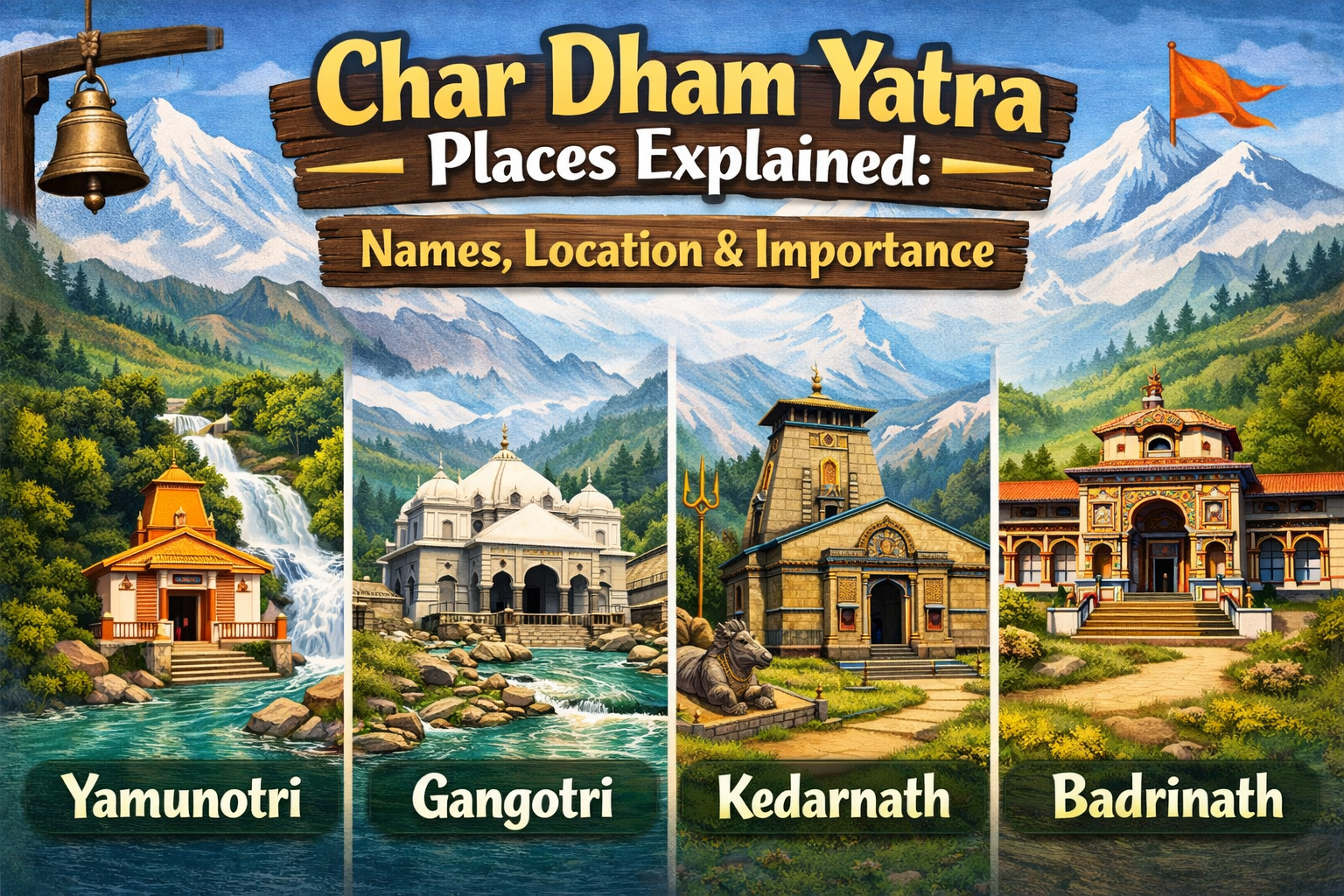
Char Dham Yatra Places Explained: Names, Location & Importance

The Char Dham Yatra places are among the holiest pilgrimage destinations in India. Located in the serene Garhwal Himalayas of Uttarakhand, these four sacred sites—Yamunotri Temple, Gangotri Temple, Kedarnath Temple, and Badrinath Temple—together form the sacred pilgrimage circuit known as the Chota Char Dham Yatra.

Every year, lakhs of devotees undertake this spiritual journey in search of purification, divine blessings, and moksha (liberation). Many pilgrims choose a well-organized Char Dham Yatra package to complete the journey comfortably and without hassle. If you are looking for detailed information about the Char Dham Yatra places, their religious significance, nearby attractions, and a complete list of destinations, this comprehensive guide covers everything you need to know.

Spiritual Importance of Char Dham Yatra

The Char Dham Yatra is also believed to be one of the most spiritually enlightening journeys for Hindus. As per the ancient Hindu scriptures, a visit to these four holy sites helps to wash away all sins and liberate a person from the cycle of life and death. The Char Dham Yatra is thus an embodiment of the purification of the soul through devotion, discipline, and surrender.


The four Char Dham sites are an embodiment of the four elements of nature and spirituality, which include water (Yamuna), purity (Ganga), destruction of ego (Shiva), and preservation of life (Vishnu). The Char Dham Yatra is also undertaken in a clockwise manner and is believed to help a person attain spiritual alignment with the cosmic forces.


Why Char Dham Yatra is Spiritually Important:

  • Believed to grant moksha (salvation)

  • Purifies mind, body, and soul

  • Connected to major Hindu scriptures

  • Associated with sacred rivers and Jyotirlinga

  • Considered one of the most powerful Himalayan pilgrimages

Char Dham Historical and Mythological Facts

The Char Dham Yatra has its roots in Hindu mythology and history. The pilgrimage was renewed in the 8th century by Adi Shankaracharya, who established these sites to combine the Hindu spiritual practices in India.


In Hindu mythology, the Ganges River, also known as Gangotri, came to earth because of the penance of King Bhagirath. Kedarnath is associated with the Pandavas of the Mahabharata epic, who wanted to take blessings from Lord Shiva after the Kurukshetra war. Badrinath is the place where Lord Vishnu meditated, and Yamunotri is the origin of the holy Yamuna River.


Important Mythological Points:

  • The Pandavas built the Kedarnath temple

  • River Ganga descended at Gangotri

  • Yamuna is the daughter of Surya Dev

  • Badrinath revived by Adi Shankaracharya

The Four Dhams in Uttarakhand

The Char Dham Yatra places in India specifically refer to the four sacred Himalayan shrines located in Uttarakhand. These four temples together form the Char Dham Yatra places list:

  • Yamunotri Temple

  • Gangotri Temple

  • Kedarnath Temple

  • Badrinath Temple

These temples are situated at altitudes ranging from 3,000 to 3,600 meters, surrounded by majestic Himalayan peaks and river valleys. Together, they form one of the most revered spiritual circuits in India.

Places to Visit During Char Dham Yatra

The Char Dham Yatra is not just about visiting the four temples. The entire trekking experience through the Garhwal Himalayas is replete with religiously significant points, natural wonders, ancient caves, holy rivers, and mythological spots. Each dham has surrounding spots that increase the religious significance of the Char Dham Yatra.


Devotees have found that the surrounding spots increase the significance of their Char Dham Yatra. From the glacier birth of holy rivers to the ancient meditation caves of sages, these spots provide both spiritual solace and spectacular views of the Himalayas. Visiting these spots will make your Char Dham Yatra places route experience even more enriching and memorable.


Below is a detailed description of the important places to visit during Char Dham Yatra, apart from the temples themselves.

Nearby Places to Visit in Yamunotri

Yamunotri is the first point in the Char Dham Yatra Circuit and is nestled amidst the unblemished natural beauty of the Himalayas. Besides the chief temple, there are several other religious sites around that add to the experience of devotees coming to this holy place.

Yamunotri Temple

This holy temple is named after the Goddess Yamuna and is situated at a height of 3,293 meters. This temple contains a black marble statue of the goddess and attracts a large number of devotees every year. This temple signifies the religious origin of the River Yamuna and represents purity and salvation from premature death.

Surya Kund

Surya Kund is a hot water spring situated near the temple. Devotees cook rice and potatoes wrapped in cloth as prasad in the boiling water of the spring and then offer it to the goddess. Surya Kund is also known for its healing properties.

Divya Shila

Divya Shila is a holy rock pillar that is located close to the temple. It has been the practice of devotees to worship this holy stone before entering the temple of Yamunotri. It is believed to be of immense good luck and spiritual power.

Kharsali Village

Kharsali is the winter home of Goddess Yamuna, as the temple remains closed due to snowfall. The village is famous for its ancient Shani Temple and wooden architecture.

Nearby Places to Visit in Gangotri

Gangotri is the second dham and symbolizes purification and devotion. It is surrounded by dense forests and towering peaks and thus provides both religious significance and natural beauty.

Gangotri Temple

This temple is made of white granite and is dedicated to the Goddess Ganga. It is located at an altitude of 3,042 meters. It symbolizes the holy origin point of the Ganga River, which is known as Bhagirathi at this location. The temple exudes a sense of calmness and purity.

Gaumukh Glacier

Gaumukh is the glacier from which the Ganga River originates. It is located at a distance of 18 km from Gangotri. The trek to Gaumukh is a religiously and naturally enriching experience. Seeing the river flowing from the glacier is a heartwarming experience.

Bhagirathi Shila

This holy rock symbolizes the penance of King Bhagirath to bring Ganga to earth. It is a place where devotees come to pray before entering the temple. It has great mythological significance.

Harsil Valley

Harsil is a peaceful valley in the Himalayas, famous for its apple orchards and natural beauty. It is a peaceful destination for devotees who want to experience calmness in the midst of their religious tour.

Nearby Places to Visit in Kedarnath

Kedarnath is the most religiously charged destination among all the Char Dham Yatra spots in India. Kedarnath is surrounded by snow-capped mountains and provides divine energy and natural beauty.

Kedarnath Temple

This ancient temple is one of the twelve Jyotirlingas of Lord Shiva and is situated at 3,583 meters. It is said to have been constructed by the Pandavas, but it was later renewed by Adi Shankaracharya. The temple environment makes it the spiritual center of the yatra.

Shankaracharya Samadhi

This spot is situated behind the temple and is the samadhi of Adi Shankaracharya. It is said that he attained moksha at this spot. The spot is of great spiritual and historical significance.

Bhairavnath Temple

Bhairavnath Temple is situated on a hill near Kedarnath and is dedicated to Lord Bhairav, who is said to be the protector of the area. Devotees often visit this temple for its panoramic views and blessings.

Vasuki Tal

Vasuki Tal is a glacial lake situated at a high altitude, about 8 km from Kedarnath. The trek to this lake provides breathtaking views of the Chaukhamba peaks and is a favorite spot for adventure enthusiasts.

Nearby Places to Visit in Badrinath

Badrinath is the last destination in the Char Dham Yatra places list and is a temple of Lord Vishnu. The temple is situated on the banks of the Alaknanda River with Neelkanth Peak as a magnificent backdrop.

Badrinath Temple

This holy Vishnu temple contains a black stone statue of Lord Badrinarayan in a meditative position. It is one of the most revered Vaishnav temples in India and draws pilgrims from all over the world.

Tapt Kund

Tapt Kund is a natural hot water spring situated at the temple's bottom. Devotees take a holy dip here before proceeding to the temple. The water possesses medicinal and purifying properties.

Mana Village

Mana is referred to as the last Indian village before the Indo-Tibetan border. It is full of mythological tales. It provides cultural knowledge and spectacular views of the Himalayas.

Vyas Gufa

Vyas Gufa is said to be the cave where Sage Ved Vyasa wrote the Mahabharata. The cave is of great spiritual and historical importance.

Bhim Pul

Bhim Pul is a natural rock bridge over the Saraswati River, said to have been positioned by Bhima of the Mahabharata. It is an intriguing mythological site.

Char Dham Yatra Places Explained

The Char Dham Yatra places are as follows: Yamunotri (Yamuna's origin), Gangotri (Ganga's origin), Kedarnath (Shiva's Jyotirlinga), and Badrinath (Vishnu temple). These holy sites form the Uttarakhand Char Dham Yatra places route, which attracts millions of devotees every year.


Every dham is special in its own way, with its own religious, mythological, and geographical significance. The Char Dham Yatra places route is a journey that includes holy rivers, ancient temples, and the mighty Himalayas, making it a spiritually uplifting and visually stunning experience.


If you are planning a Char Dham Yatra places package, then knowing about these places and other options around them will help you have a complete and enriching spiritual experience.

Final Words

The Char Dham Yatra places are more than just temples—they are sacred spiritual destinations nestled in the majestic Himalayas of Uttarakhand. From the holy waters of Yamunotri Temple and Gangotri Temple to the divine presence of Kedarnath Temple and the peaceful aura of Badrinath Temple, each destination plays a vital role in highlighting the significance of Char Dham Yatra. Together, these sacred sites create a powerful spiritual journey that represents purification, devotion, and the path toward inner peace and liberation.

Whether you are searching for the char dham yatra places list, embarking on the char dham yatra route, or even finalizing a pilgrimage tour, understanding the significance of each dham will prepare you for a life-transforming experience.

Frequently Asked Questions for Char Dham Yatra Places

1. Which places are included in the Char Dham Yatra?

Char Dham Yatra includes four sacred pilgrimage sites in Uttarakhand: Yamunotri, Gangotri, Kedarnath, and Badrinath. These temples are located in the Himalayan region and are visited in a fixed traditional order.

2. What are the four dham locations in Char Dham Yatra?

The four dham locations are Yamunotri in Uttarkashi district, Gangotri near the origin of the River Ganga, Kedarnath in Rudraprayag district, and Badrinath in Chamoli district of Uttarakhand.

3. Why are Char Dham Yatra places spiritually important?

Char Dham Yatra places are believed to help devotees attain spiritual purification and inner peace. Visiting these sacred temples is considered a path toward liberation and divine blessings in Hindu tradition.

4. What is the religious significance of Char Dham Yatra temples?

Each temple represents a different divine energy. Yamunotri honors Goddess Yamuna, Gangotri is dedicated to Goddess Ganga, Kedarnath to Lord Shiva, and Badrinath to Lord Vishnu, symbolizing balance between creation, preservation, and transformation.

5. What is the history behind Char Dham Yatra places?

The Char Dham pilgrimage tradition was popularized by Adi Shankaracharya in the 8th century to unify spiritual practices across India. He established temple importance and encouraged pilgrims to complete the sacred circuit.

6. What are the mythological stories of Char Dham Yatra?

Mythology links Yamunotri to the daughter of the Sun God, Gangotri to the descent of River Ganga to Earth, Kedarnath to Lord Shiva appearing before the Pandavas, and Badrinath to Lord Vishnu meditating in the Himalayas.

7. Which dham is the most important in Char Dham Yatra?

All four dhams are equally important spiritually, but Kedarnath is often considered especially significant because it is one of the twelve Jyotirlingas of Lord Shiva.

8. What nearby places can we visit during Char Dham Yatra?

Travelers often visit places like Harsil Valley near Gangotri, Triyuginarayan Temple near Kedarnath, Mana Village near Badrinath, and Surya Kund at Yamunotri during the journey.

9. Which cities are closest to Char Dham Yatra places?

Major nearby cities include Dehradun, Rishikesh, and Haridwar, which serve as main starting points for Char Dham Yatra travel.

10. What are the best sightseeing spots around the Char Dham temples?

Popular sightseeing spots include Vasudhara Falls near Badrinath, Bhairavnath Temple near Kedarnath, Harsil Valley near Gangotri, and scenic trekking routes around Yamunotri.

Read Full Story
Blog
Char Dham YatraMarch 5, 2026

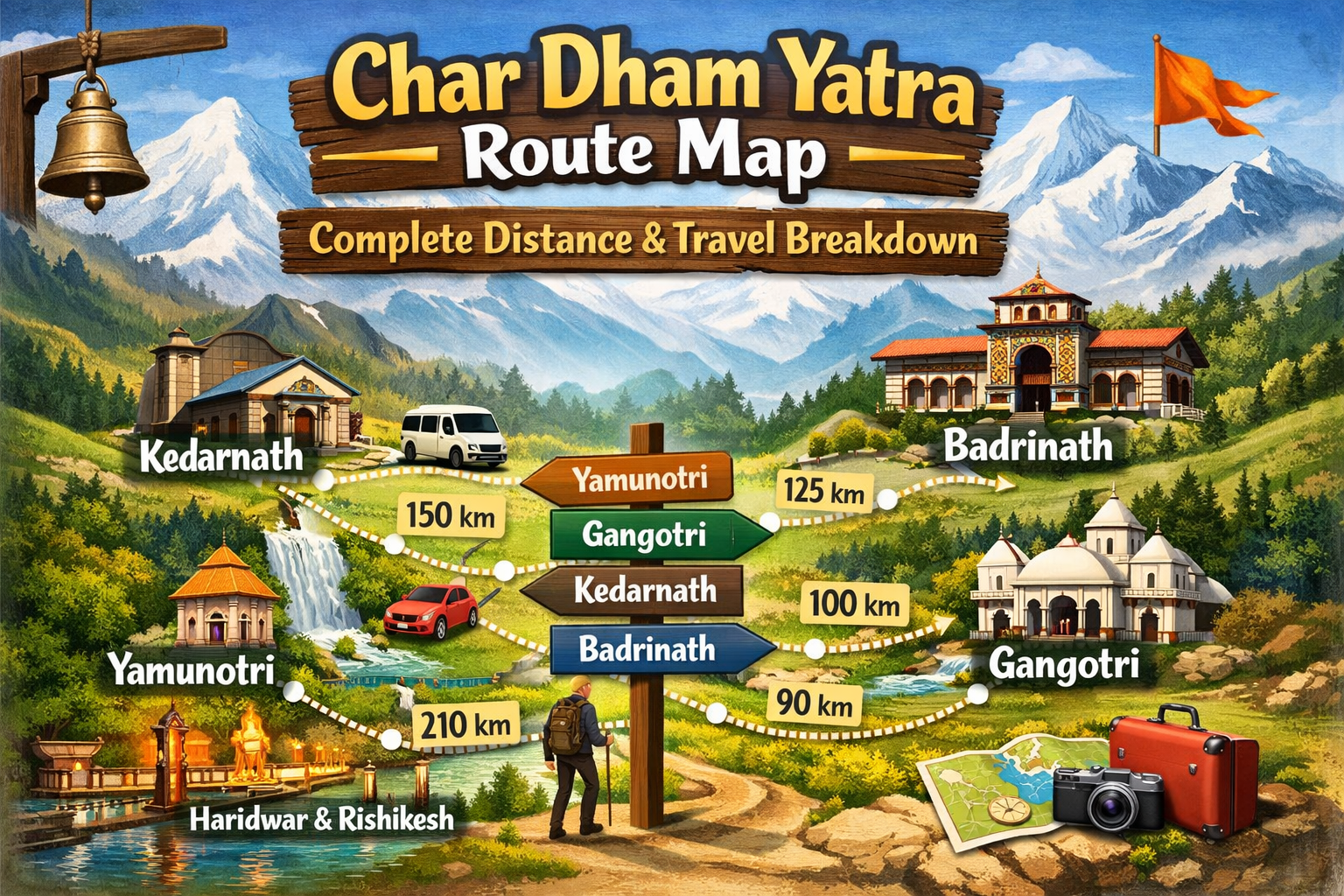
Char Dham Yatra Route Map: Complete Distance & Travel Breakdown

To plan a successful Char Dham Yatra in Uttarakhand, it is important to know about the Char Dham Yatra route map in detail. The Char Dham Yatra is a spiritual route that connects four holy shrines in the Himalayas: the Yamunotri Temple, the Gangotri Temple, the Kedarnath Temple, and the Badrinath Temple, which together make up the Chota Char Dham of Uttarakhand.


Each year, lakhs of devotees embark on this high-altitude journey, covering a distance of 1,500–1,600 kilometers, often opting for a well-planned char dham yatra package to ensure a smooth experience. However, the Char Dham Yatra route map is not just a spiritual path that a devotee follows; it is also a journey that requires proper planning, along with a clear understanding of the terrain, road conditions, and changing weather patterns


This comprehensive guide will help you understand the terrain and travel logistics of the Char Dham Yatra route map in detail.

What is the Char Dham Circuit?

The Char Dham circuit is the traditional clockwise journey undertaken by devotees in Uttarakhand. The journey typically begins from Haridwar or Rishikesh and then moves in the following order: Yamunotri, Gangotri, Kedarnath, and finally Badrinath.


The circuit passes through the Garhwal Himalayas and includes valleys, points where the holy rivers meet, pine forests, and mountain ranges covered with snow. The char dham yatra also varies in altitude from 3,000 meters to above 3,500 meters. This makes the circuit both spiritually and physically taxing.


The Char Dham circuit typically takes 10-12 days to complete by road and includes treks to Yamunotri and Kedarnath.


Important Highlights of the Char Dham Circuit:

  • Starts from Haridwar or Rishikesh

  • Follows a clockwise religious sequence

  • Covers approximately 1,500–1,600 km by road

  • Includes 5 km trek to Yamunotri

  • Includes 17 km trek to Kedarnath

  • Considered one of the most sacred pilgrimages in India

Char Dham Yatra Route Map with Distance From Haridwar

It is important to understand the char dham yatra route map with distance from Haridwar in order to plan the journey properly. The journey is segmented into various parts, with some fixed base points for each of the temples. The devotees need to plan for the long drives in the mountains, the roads, the fueling points, and the trekking routes.


Here is the Char Dham Yatra by Road Route Map. With Distance that is normally followed:


Route Segment

Approx Distance (KM)

Details

Haridwar – Barkot

210 km

Via Dehradun & Mussoorie

Barkot – Janki Chatti

45 km

Road journey

Janki Chatti – Yamunotri

5 km

Trek

Barkot – Uttarkashi

95 km

Mountain road

Uttarkashi – Gangotri

100 km (one side)

Fully motorable

Uttarkashi – Guptkashi

220 km

Long hilly stretch

Guptkashi – Sonprayag

35 km

Road access

Sonprayag – Kedarnath

17 km

Trek

Guptkashi – Joshimath

160 km

Via Chopta

Joshimath – Badrinath

45 km

Smooth motorable road

Badrinath – Haridwar

300 km approx

Return via Devprayag

Total road distance: Approximately 1,500 km (excluding trekking).

This detailed char dham map with distance helps pilgrims estimate travel time, fuel, and arrange overnight stays.

How risky is the Char Dham Yatra?

The Char Dham Yatra is a journey through the high-altitude Himalayan regions, which in itself poses some natural risks. These risks are associated with high-altitude routes, landslides, and extreme weather conditions.


But the development projects undertaken by the government, such as the expansion of the Char Dham Highway, have improved the situation to a great extent. The government also sets up disaster relief teams and medical camps during the yatra period.


The major risk factors are:

  • Landslides during the monsoon season

  • High-altitude sickness above 3,000 meters

  • Sharp hairpin bends on mountain roads

  • Traffic congestion during peak months (May–June)

  • Sudden temperature drops in higher regions

All these risks can be overcome with proper planning and awareness.

Char Dham Yatra Road Condition

The road conditions along the Char Dham route vary depending on the region and the time of year. The journey from Haridwar to Barkot is relatively smooth, but once you enter the Himalayan ranges, the roads become narrower, winding, and more challenging.
 

There are also road widening projects in progress. This might cause some diversions. Some parts of the route near Guptkashi and Sonprayag have steep climbs and turns, which demand expert driving.


General Road Condition Overview:

  • Haridwar to Barkot: Mostly smooth highway

  • Barkot to Uttarkashi: Moderate mountain road

  • Uttarkashi to Gangotri: Narrow but motorable

  • Guptkashi to Kedarnath base: Steep and winding

  • Joshimath to Badrinath: High-altitude but stable

Avoid night driving in mountainous areas for better safety.

Weather Conditions at Char Dham Yatra

The weather conditions affect the Char Dham Yatra route map journey. The temperatures vary greatly due to the high altitude. Even in the summer season, the nights can be very cold at Kedarnath and Badrinath.


The monsoon season (July-August) is prone to landslides and road closures. The post-monsoon season (September-October) is characterized by clear skies and favorable conditions.


Seasonal Weather Breakdown:

  • May–June: Pleasant (5°C to 20°C), peak season

  • July–August: Heavy rainfall, landslides possible

  • September–October: Clear skies, ideal travel

  • November–April: Heavy snowfall, temples closed

Carrying woolens and rain protection is essential in all seasons.

Is Char Dham Yatra Safe?

Yes, the pilgrimage is said to be safe if done during the official char dham yatra season and after proper registration. The Uttarakhand government has made biometric registration compulsory, and medical facilities are also available on the route.


Security forces, emergency services, and health camps are available on the entire route. It is advised that pilgrims take note of the official warnings and weather updates.


Safety Recommendations:

  • Complete government registration

  • Travel during recommended months

  • Stay updated on weather forecasts

  • Consult a doctor before travel

  • Avoid overexertion during treks

Senior citizens and those with heart or respiratory issues should seek medical clearance before traveling.

Can We Do the Char Dham Yatra by Our Own Car?

Although self-driving offers flexibility and autonomy, it also demands mountain driving confidence and car readiness.


The terrain is characterized by steep ascents, sharp corners, and long driving distances. Petrol stations become scarce in higher altitudes; thus, appropriate planning is required.


If Traveling by Your Own Car:

  • Prefer an SUV or a high ground-clearance vehicle

  • Ensure brakes and engine are in top condition

  • Carry a spare tire and an emergency toolkit

  • Keep the fuel tank sufficiently filled

  • Avoid driving at night in the hills

  • Check weather updates before departure

For first-time visitors, hiring an experienced mountain driver is often recommended.

Helpful Tips for Safe Char Dham Yatra

Preparation is the key to a smooth pilgrimage along the 4 Dham Yatra Route Map. Since the journey covers several high-altitude areas, it is necessary to be physically prepared and pack accordingly.


It is necessary to plan each day of the journey carefully and start early to avoid traffic congestion. Acclimatization breaks should also be taken when necessary. The Himalayan ecosystem should be respected by not littering and following eco-guidelines.


Important Travel Tips:

  • Start early each morning

  • Stay hydrated and eat light meals

  • Carry woolens, rain gear, and sturdy footwear

  • Keep essential medicines and a first aid kit

  • Maintain proper acclimatization

  • Keep ID proof and registration slip handy

  • Follow temple guidelines and local advisories

Final Thoughts

The Char Dham Yatra route map is more than just a distance map; it is a tool that helps one prepare for one of the most sacred journeys in the Himalayas of India. While one can learn about the Char Dham Yatra map with distances, it is essential to assess the road conditions and safety measures that need to be taken.


Whether you are traveling with your family, planning a self-drive trip, or taking a package tour, it is essential to learn about the char dham route map in detail to prepare for the terrain and weather conditions. With devotion in your heart and preparation in your plan, the Chota Char Dham of Uttarakhand is not just a journey; it is an experience that can change one’s life.

Frequently Asked Questions for Char Dham Yatra Route Map

1. What is the Char Dham Yatra route map and travel order?

The traditional Char Dham Yatra route in Uttarakhand follows a clockwise direction. The travel order is Yamunotri first, then Gangotri, followed by Kedarnath, and finally Badrinath. This sequence follows religious tradition and practical road connectivity.

2. What is the Char Dham circuit route from Haridwar?

The Char Dham circuit from Haridwar typically follows this route:
Haridwar → Barkot → Yamunotri → Uttarkashi → Gangotri → Guptkashi or Sonprayag → Kedarnath → Joshimath → Badrinath → Rishikesh → Haridwar.

3. How many kilometers is the Char Dham Yatra distance from Haridwar?

The total Char Dham Yatra distance from Haridwar is approximately 1,500 to 1,600 kilometers by road, including travel between all four temples and the return journey.

4. Can we do the Char Dham Yatra by car, and is the road safe?

Yes, the Char Dham Yatra can be done by car. Roads are motorable and maintained during the Yatra season, but mountain driving experience is recommended due to steep turns and narrow stretches.

5. How risky is the Char Dham Yatra for travelers?

Char Dham Yatra is generally safe when planned properly. Risks mainly include altitude sickness, weather changes, and mountain road conditions. Traveling during the official season and following safety guidelines reduces risks significantly.

6. What are the current road conditions on the Char Dham Yatra route?

Road conditions are usually good during the pilgrimage season, with ongoing highway improvements under the Char Dham road project. However, occasional delays may occur due to landslides or weather in mountainous areas.

7. How many days are needed to complete the Char Dham Yatra from Haridwar?

Most travelers need 10 to 12 days to complete the Char Dham Yatra from Haridwar comfortably, allowing time for travel, rest, and temple darshan.

8. What are the weather conditions during the Char Dham Yatra month-wise?

May to June offers pleasant weather with cool temperatures. July and August bring monsoon rains and possible travel disruptions. September to October has clear skies and colder mornings and nights, especially near Kedarnath and Badrinath.

9. Which dham comes first in the Char Dham Yatra route map?

Yamunotri is the first dham visited in the Char Dham Yatra route map, followed by Gangotri, Kedarnath, and Badrinath.

10. What are some helpful tips before starting the Char Dham Yatra?

Register online before travel, carry warm clothes, keep a valid ID proof, pack essential medicines, stay hydrated, and allow time for altitude adjustment. Booking accommodation and transport in advance is also recommended.

Read Full Story
Blog
Char Dham YatraFebruary 26, 2026

The Char Dham Yatra – Complete Guide to the Sacred 4 Dham of Uttarakhand

The Char Dham Yatra is one of the holiest Hindu pilgrimages in India, attracting millions of devotees every year to the breathtaking Garhwal Himalayas in Uttarakhand. This religious tour of the four holy shrines, Yamunotri, Gangotri, Kedarnath, and Badrinath, is commonly referred to as the Char Dham of Uttarakhand or Chota Char Dham Yatra.


For ages, the devotees have believed that this holy journey cleanses the soul of all sins and brings them closer to moksha (liberation). But now, with the development of roads, helicopter services, and effective Char Dham Yatra packages, this journey has become easier for families, senior citizens, and devotees from India and abroad.


If you are preparing for a Trip to Char Dham Temples, this comprehensive Char Dham Yatra Complete Guide has all the information on origin, tour itinerary, route map, registration procedure, cost analysis, best time to visit, and some valuable travel tips.

The Origin of Char Dham Yatra

The idea of Char Dham was established in the 8th century by the renowned Hindu philosopher and reformer Adi Shankaracharya. He aimed to give a common spiritual identity to India by establishing four holy pilgrimage centers.


The Himalayan trek in Uttarakhand has gained immense popularity over the years and is now referred to as the Chota Char Dham Yatra, which comprises:


  • Yamunotri Temple

  • Gangotri Temple

  • Kedarnath Temple

  • Badrinath Temple


This religious tour is taken in a clockwise manner, starting from Yamunotri and culminating at Badrinath.

About the Char Dham of Uttarakhand

The Char Dham of Uttarakhand, referred to as the Chota Char Dham Yatra, comprises four holy shrines of the Himalayas: the Yamunotri Temple, the Gangotri Temple, the Kedarnath Temple, and the Badrinath Temple. Each of these temples has a rich spiritual significance and is associated with a holy river and a prominent Hindu god.

1. Yamunotri Dham

At an altitude of 3,293 meters, the Yamunotri Temple is dedicated to the Goddess Yamuna and is the source of the holy river of the Yamuna. It is also believed to save devotees from premature death and cleanse their souls. The temple contains a black marble statue of the goddess and is also known for its hot water springs, where devotees take ritual baths before visiting the temple.

2. Gangotri Dham

At an altitude of 3,042 meters, the Gangotri Temple is dedicated to Goddess Ganga. According to legend, the River Ganga, the holy river of Hinduism, fell from the heavens at this sacred place. The temple is surrounded by snow-capped granite mountains and is known for its serene environment.

3. Kedarnath Dham

Kedarnath Temple, at 3,583 meters, is one of the 12 Jyotirlingas of Lord Shiva. It has a very strong link with the epic Mahabharata and the Pandavas. It is also believed to be the most pious and spiritual experience of the yatra. Devotees have to trek 18-20 km from Gaurikund to reach Kedarnath and take blessings from Lord Shiva. The temple is surrounded by massive snow-capped Himalayan peaks, and the spiritual and peaceful environment of the temple makes the journey very tough and spiritual.

4. Badrinath Dham

Badrinath Temple is situated at 3,133 meters on the banks of the River Alaknanda. It is a temple of Lord Vishnu and one of the most revered Vaishnav temples in India. It is also the last destination of the Char Dham Yatra. The temple contains a black idol of Lord Badrinarayan in a meditative position. It is a tradition to take a dip in the Tapt Kund before having darshan.

Chota Char Dham Yatra Season

The Char Dham temples are closed for a period of six months in a year because of harsh winter conditions.


  • Opening Time: April/May (Akshaya Tritiya)

  • Closing Time: October/November (Diwali)

  • Peak Season: May and June (heavy rush and pleasant weather)

  • Best Season: September and October (clear skies and fewer crowds)

  • Rainy Season: July and August (heavy rainfall and landslides)


The weather in the region is unpredictable. Even during the summer season, the night temperature at Kedarnath can be below freezing.

Best Time to Visit Char Dham Yatra

The best time to visit, depending on your preference for travel:

  • For comfortable weather: May–June

  • For peaceful darshan and fewer crowds: September–October

  • Avoid: Monsoon season due to landslide risks

Proper planning ensures a smooth and spiritually fulfilling experience.

Char Dham Yatra Route Map

The traditional Char Dham Yatra by road follows this sequence:

Haridwar/Rishikesh → Barkot → Yamunotri → Barkot → Uttarkashi → Gangotri → Uttarkashi → Guptkashi/Sonprayag → Gaurikund → Kedarnath → Gaurikund → Guptkashi/Sonprayag → Badrinath → Haridwar/Rishikesh

  • Total distance covered: approximately 1,500–1,600 km

  • Duration: 10–12 days

The route passes through scenic Himalayan valleys, rivers, and spiritual towns.

Detailed Char Dham Itinerary from Haridwar

A well-planned Char Dham itinerary from Haridwar ensures that your pilgrimage remains smooth, spiritually enriching, and free from last-minute travel hassles. Since Haridwar is one of the main starting points for the yatra, most pilgrims prefer beginning their sacred journey from here. A properly structured schedule helps you cover Yamunotri, Gangotri, Kedarnath, and Badrinath in the traditional sequence, allowing adequate time for travel, rest, and temple darshan.

Day 1: Haridwar – Barkot (via Dehradun & Mussoorie)

Your pious tour starts early in the morning from Haridwar. The journey will take you through Dehradun and the popular hill station of Mussoorie. If time and traffic conditions allow, you can visit the stunning Kempty Falls. Proceed to Barkot, situated on the banks of the river Yamuna. On arrival, check into the hotel, relax, have dinner, and get ready for the first dham destination.

Day 2: Barkot – Yamunotri – Barkot

Early morning (around 4:00 AM) start your journey to Janki Chatti (approx. 42 km away). From there, trek to the Yamunotri Temple on foot, pony, or doli (to be arranged at your own cost). On arrival, take a dip in the sacred Jamnabai Kund and visit the temple. After the darshan, return to Janki Chatti and then to Barkot for an overnight stay.

Day 3: Barkot – Uttarkashi

After breakfast, proceed to Uttarkashi (approx. 95 km). On the way, visit Prakateshwar Mahadev Temple. On arrival, check into your hotel and take some rest. Uttarkashi is a religiously significant place, located on the banks of the Bhagirathi River.

Day 4: Uttarkashi – Gangotri – Uttarkashi

Early morning departure (approx. 5:00 AM) for Gangotri Temple (100 km each way). Take a dip in the River Ganga (Bhagirathi at its source) and visit the temple darshan. On the return journey, visit Kashi Vishwanath Temple in Uttarkashi before returning to your hotel.

Day 5: Uttarkashi – Guptkashi

After breakfast, proceed to Guptkashi (approx. 223 km, 9-10 hours). The journey is full of breathtaking views of the Himalayas. On arrival, check into your hotel and take some rest for the next day’s journey to Kedarnath.

Day 6: Guptkashi – Kedarnath

Early morning departure for Sonprayag/Sitapur. From there, start the 17 km trek to Kedarnath Temple. Devotees can either trek or take ponies/doli (at their own cost). In the evening, visit Shankaracharya Samadhi and attend the divine aarti at the temple. Overnight stay at Kedarnath (arranged by yourself).

Day 7: Kedarnath – Guptkashi

Early morning darshan at Kedarnath Temple. After darshan, trek back to Sonprayag and then drive to Guptkashi. Check in at the hotel and take a relaxing break after the tiring trek.

Day 8: Guptkashi – Joshimath / Pipalkoti

Post breakfast, proceed to Joshimath or Pipalkoti. On arrival, check-in at the hotel and spend a relaxing evening in the midst of the Himalayas.

Day 9: Badrinath & Mana Village Sightseeing

Visit Badrinath Temple. Take a holy dip in Tapt Kund prior to temple darshan. Later, visit Mana Village (the last village before the Indo-Tibetan border), Vyas Gufa, Ganesh Gufa, Bhim Pul, and the Saraswati River's origin point. Return to the hotel for dinner and overnight stay.

Day 10: Joshimath – Rishikesh – Haridwar

Post breakfast, proceed to Rishikesh (150 km). En route, visit Devprayag, the holy confluence of Alaknanda and Bhagirathi Rivers. In Rishikesh, visit Laxman Jhula, Ram Jhula, Geeta Bhavan, and witness the evening Ganga Aarti at Triveni Ghat. Later, proceed to Haridwar, thus concluding the Char Dham Yatra.

Option: Char Dham Yatra by Helicopter

For pilgrims with limited time, the Char Dham Yatra by helicopter completes the journey in 4–6 days. It includes VIP darshan, premium accommodation, minimal trekking, and enhanced comfort, ideal for senior citizens and luxury travelers.

Char Dham Yatra Registration

Registration is mandatory for all pilgrims as per the guidelines of the Uttarakhand government.

Registration Options:

  • Online registration portal

  • Offline counters at key locations

Required Documents:

  • Valid government ID

  • Mobile number

  • Travel details

Biometric verification ensures safety tracking throughout the pilgrimage.

Char Dham Yatra Cost Breakdown

The cost of Char Dham Yatra package varies based on comfort level and mode of travel.

Budget Package (By Road)

  • ₹25,000 – ₹35,000 per person

  • Includes transport, accommodation, and meals.

Deluxe or Family Package

  • ₹40,000 – ₹65,000 per person

  • Includes better hotels, upgraded vehicles, and priority assistance.

Char Dham Yatra by Helicopter

  • ₹1,80,000 – ₹2,50,000 per person

  • Includes helicopter transfers, premium stay, VIP darshan.

A customized Char Dham Yatra family package ensures comfortable travel for elders and children.

Char Dham Yatra by Road vs Helicopter

Whether to opt for a Char Dham Yatra by road or a Char Dham Yatra by helicopter is largely dependent on your budget, availability of time, health, and personal preferences. While the Char Dham Yatra by road provides a very immersive experience in the spiritual and scenic aspects of the Himalayan valleys, the helicopter tour provides comfort, speed, and convenience.


Both options are available for devotees to undertake the sacred pilgrimage to the Yamunotri Temple, Gangotri Temple, Kedarnath Temple, and Badrinath Temple.


Below is a detailed comparison to help you decide:


Feature

Char Dham Yatra by Road

Char Dham Yatra by Helicopter

Duration

10–12 days

4–6 days

Cost

Budget-friendly

Premium

Travel Experience

Scenic Himalayan drive through valleys and rivers

Aerial views of the Himalayas

Physical Effort

Includes long drives and the Kedarnath trek

Minimal trekking required

Best For

Families, groups, spiritual seekers

Senior citizens, luxury travelers

Comfort Level

Standard to deluxe (depending on package)

High comfort with VIP darshan

Spiritual Feel

Traditional and immersive

Fast yet spiritually fulfilling

Ultimately, the choice depends on your priorities. If you value a slow, traditional journey and budget travel, the road option is perfect. If comfort, time efficiency, and convenience are your focus, the helicopter yatra is the best choice.

Do’s and Don’ts for Char Dham Yatra

Do’s:

  • Carry warm clothing and rain gear

  • Stay hydrated

  • Follow temple customs

  • Keep emergency medicines

  • Book your package in advance

Don’ts:

  • Avoid alcohol and non-vegetarian food

  • Do not litter

  • Avoid risky shortcuts during trekking

  • Do not ignore altitude sickness symptoms

Responsible travel ensures safety and preserves the fragile Himalayan ecosystem.

Why Book a Char Dham Yatra Package from Kinghills Travels?

Organizing a Char Dham Yatra on your own may seem like a feasible task, but in fact, it involves a lot of complexities, such as high altitude, unavailability of accommodations, unpredictable weather, and government restrictions. The Himalayan region is unpredictable, and sudden changes such as hotel unavailability or transport problems can easily hamper your Char Dham Yatra. Therefore, to make your Char Dham Yatra a safe and successful one, it is always better to choose a 4 Dham Yatra package from a professional travel agency such as Kinghills Travels.

The agency has extensive experience in organizing Char Dham Yatras. Kinghills Travels are aware of the route, temple timings, registration procedures, and seasonal difficulties. Whether you are traveling with your family, elderly people, or a group, a planned Char Dham Yatra package makes a lot of difference.

Here’s what you can expect when booking your Char Dham Yatra package with Kinghills Travels:

  • Pre-arranged quality hotels at every destination

  • Experienced mountain drivers trained for Himalayan terrain

  • 24/7 customer assistance throughout the journey

  • Emergency assistance when needed

  • Seamless itinerary planning for darshan timings and travel schedules

  • Assistance with Char Dham registration and permits

Professional planning not only reduces stress but also enables you to focus entirely on your spiritual experience. From Yamunotri to Badrinath, every detail is carefully managed so that you can undertake this sacred pilgrimage with peace of mind and devotion.

Final Words

Through the divine Himalayas. Right from the spiritual waters of Yamunotri and Gangotri to the divine presence of Kedarnath and the calmness of Badrinath, every step takes you closer to your faith and peace.


No matter whether you opt for the classic Char Dham Yatra by road or the luxurious Char Dham Yatra by helicopter, a proper plan will help you have a safe, comfortable, and pious experience.


If you are planning to book a Char Dham Yatra package, make sure to select a reliable travel companion to make your religious tour simply divine and smooth.

Frequently Asked Questions for Char Dham Yatra Complete Guide

1. What is Char Dham Yatra, and which temples are included?

Char Dham Yatra is one of the most sacred Hindu pilgrimages in India, located in Uttarakhand. It includes visits to four holy temples: Yamunotri, Gangotri, Kedarnath, and Badrinath. These shrines are dedicated to Goddess Yamuna, Goddess Ganga, Lord Shiva, and Lord Vishnu, respectively. Completing the Char Dham Yatra is believed to cleanse sins and bring spiritual peace.

2. What is the best time to visit Char Dham Yatra?

The best time to visit Char Dham Yatra is from May to June and September to October. During these months, weather conditions are relatively stable, and routes remain accessible. The monsoon season from July to August is usually avoided due to heavy rainfall and landslide risks.

3. How many days are required for the Char Dham Yatra itinerary?

A complete Char Dham Yatra itinerary typically requires 10 to 12 days by road. The duration may vary depending on the travel starting point, weather conditions, and chosen travel mode, such as road travel or helicopter services.

4. How to register for the Char Dham Yatra online?

Pilgrims must complete online registration through the official Uttarakhand government portal. Registration involves providing personal details, uploading ID proof, selecting travel dates, and downloading the Yatra registration pass, which is mandatory for temple visits.

5. What is the Char Dham Yatra route map and travel order?

The traditional travel order followed during Char Dham Yatra is Yamunotri first, then Gangotri, followed by Kedarnath, and finally Badrinath. This sequence follows religious traditions and geographic convenience, starting from west to east in Uttarakhand.

6. How much does a Char Dham Yatra package cost in India?

The cost of a Char Dham Yatra package in India usually ranges between INR 30,000 to INR 80,000 per person for road tours, depending on accommodation type, inclusions, and travel starting city. Luxury and helicopter packages cost significantly more.

7. Is the Char Dham Yatra by helicopter worth it, and how much does it cost?

Char Dham Yatra by helicopter is worth considering for travelers with limited time or physical constraints. It reduces travel duration and avoids long road journeys and treks. Helicopter packages generally cost between INR 1.8 lakh to INR 2.5 lakh per person, depending on services and duration.

8. Can senior citizens do the Chota Char Dham Yatra safely?

Yes, senior citizens can safely complete the Chota Char Dham Yatra with proper planning. Choosing comfortable accommodations, taking rest days, consulting a doctor before travel, and using helicopter or pony services for the Kedarnath trek can make the journey easier.

9. What documents are required for Char Dham Yatra registration?

Travelers typically need a valid government ID such as an Aadhaar Card, Voter ID, Passport, or Driving License. Mobile number verification and registration confirmation are also required during the Yatra.

10. Which is better, the Char Dham Yatra by road or by helicopter?

Char Dham Yatra by road is ideal for pilgrims who want a traditional spiritual journey and scenic Himalayan experience. Helicopter travel is better for those with limited time, elderly travelers, or anyone looking for a more comfortable and faster option. The best choice depends on budget, health, and travel preferences.

Read Full Story

Pick top destinations for your next holiday

Subscribe

Our Newsletter

Stay informed about exciting destinations and exclusive travel deals.

Download

Mobile App

Download Kinghills Travels App to Book Your Trip With Exciting Offers.