
 UAE
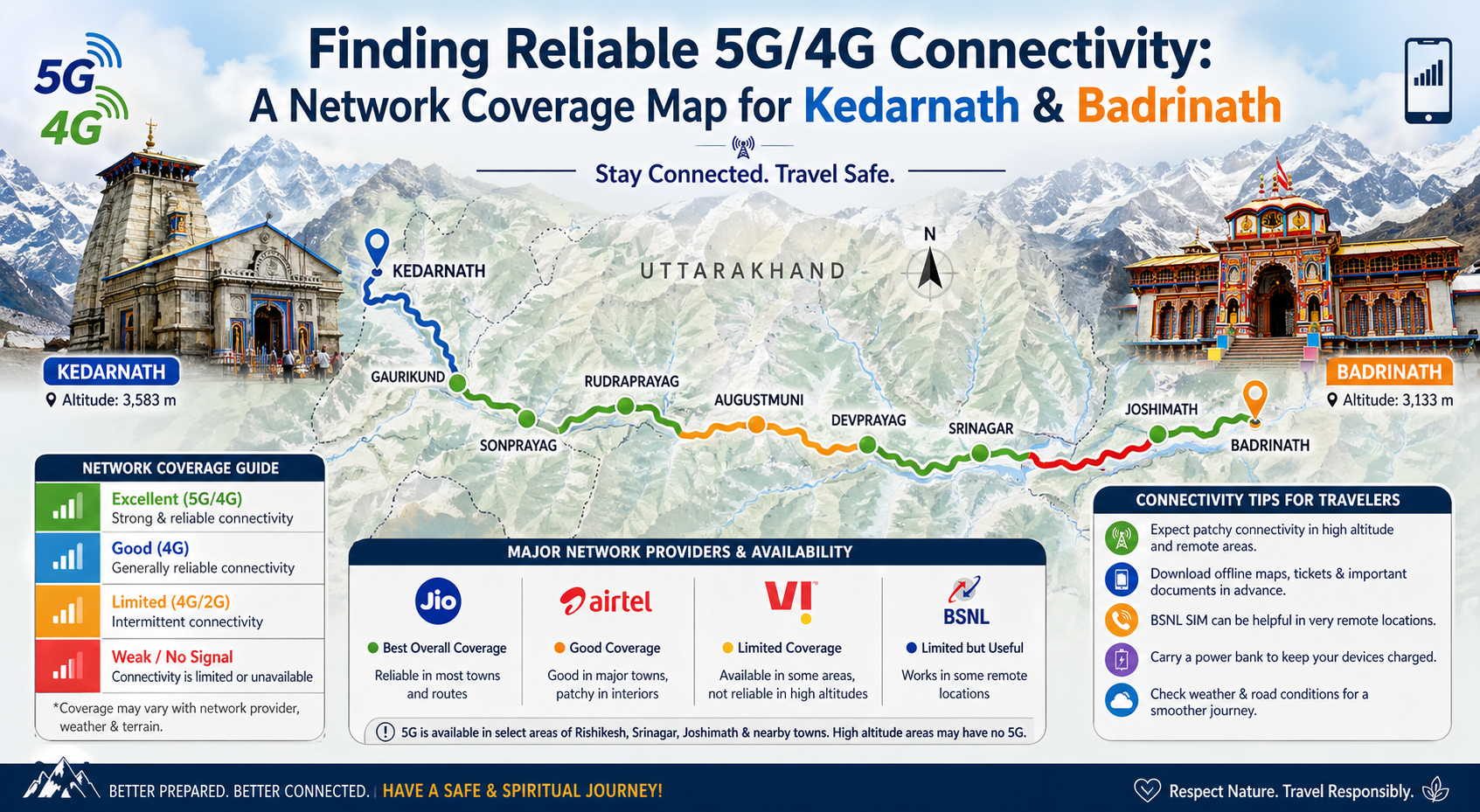
UAEFinding Reliable 5G/4G Connectivity: A Network Coverage Map for Kedarnath & Badrinath
📑 Table of Contents
Staying connected during the Do Dham Yatra is one of the biggest concerns for travelers today, especially as more people rely on smartphones for navigation, bookings, and communication. When it comes to mobile network in Kedarnath and Badrinath, the reality is very different; connectivity is limited, inconsistent, and highly location-dependent. Many travelers assume that modern networks like 4G or even 5G will work seamlessly, but the mountainous terrain of Uttarakhand presents serious challenges. Network availability changes drastically between towns, trek routes, and temple areas. While some spots may offer usable signal, others fall into complete blackout zones. Understanding which SIM card works best and where you can expect connectivity is crucial before starting your journey.
This guide provides a complete, ground-level breakdown of network conditions so you can stay prepared. By the end, you’ll know exactly how to stay connected during your Do Dham Yatra without frustration.
Overview of Mobile Connectivity in Kedarnath & Badrinath
Mobile connectivity in Kedarnath and Badrinath is highly unpredictable due to altitude, terrain, and limited telecom infrastructure. While both destinations are major pilgrimage sites, they are located in remote Himalayan regions where network towers are sparse. Connectivity tends to improve slightly during peak do dham yatra season when temporary infrastructure is strengthened, but it is still far from reliable. In general, only a few networks function consistently, and even those may fluctuate depending on weather and crowd density. Voice calls are usually more reliable than mobile internet, which often drops or becomes extremely slow.
Travelers should not expect continuous internet access throughout the journey. Instead, connectivity should be treated as occasional rather than constant. Being mentally prepared for limited access can make your experience much smoother.
-
Signal is weak and inconsistent in both Kedarnath and Badrinath
-
Internet is slower compared to the plains
-
Voice calls work better than data services
-
Connectivity improves slightly during peak season
Jio vs Airtel vs BSNL: Which Network Works Best in Kedarnath?
Choosing the right SIM card is one of the most important decisions for this trip. Among all telecom providers, BSNL has historically performed the best in remote Himalayan regions. This is mainly because BSNL has older infrastructure specifically designed for rural and high-altitude coverage. Jio and Airtel, while strong in cities, often struggle in extreme terrains like Kedarnath. However, they may still work in certain areas with limited signal. No single network works perfectly everywhere, which is why many experienced travelers carry dual SIMs. Having backup connectivity can be extremely helpful in emergencies. Below is a realistic comparison based on recent travel experiences.
-
BSNL network in Kedarnath: Most reliable for basic calls and limited data
-
Does Jio work in Kedarnath? Works in patches, mainly near base areas
-
Airtel performance: Slightly better than Jio in some zones but still inconsistent
-
Best network in Kedarnath: BSNL overall
Which SIM Works in the Kedarnath Temple Area?
The Kedarnath temple area is one of the most challenging locations for mobile connectivity. Due to its high altitude and surrounding mountains, signal strength is extremely weak. Most private networks struggle to maintain consistent coverage in this zone. BSNL remains the most dependable option, although even it may not provide strong internet speeds. Travelers often experience fluctuating signal even within short distances. During peak season, network congestion further reduces performance. It’s important to manage expectations and use connectivity only when necessary. Below is what you can realistically expect in the temple area.
-
BSNL works intermittently near the temple
-
Jio and Airtel have very limited connectivity
-
The Internet is slow and unreliable
-
Calls may drop frequently
Mobile Network in Do Dham Yatra (Kedarnath & Badrinath)
When looking at the entire Do Dham Yatra, network availability varies significantly between locations. Badrinath generally has better connectivity compared to Kedarnath due to better road access and infrastructure. Kedarnath, being accessible only via trek, has more limited network coverage. However, even in Badrinath, internet speeds may not match urban standards. Travelers should plan their communication accordingly. Understanding location-wise connectivity helps in better planning. Below is a general overview across both dhams.
-
Kedarnath: Limited and unstable network
-
Badrinath: Moderate connectivity in the town area
-
Internet availability: Basic browsing possible in Badrinath
-
Calls: More reliable in Badrinath than Kedarnath
Best SIM Card for Do Dham Yatra
Selecting the best SIM card for the entire journey requires balancing coverage and reliability. Since no single network works perfectly across all locations, choosing the right combination is key. BSNL is widely considered the best option for remote coverage, especially in Kedarnath. However, Jio and Airtel may still be useful in towns like Badrinath and Haridwar. Carrying at least two SIM cards increases your chances of staying connected. This approach is commonly followed by experienced travelers. Below is the recommended strategy.
-
Primary SIM: BSNL
-
Secondary SIM: Jio or Airtel
-
Device Recommendation: Use a dual SIM phone for better connectivity
-
Tip: Keep both SIM cards active throughout the journey
Network Connectivity on Kedarnath Trek Route (Gaurikund to Kedarnath)
The trek from Gaurikund to Kedarnath is one of the most challenging areas for mobile connectivity. As you move higher, network coverage becomes weaker and eventually disappears in certain stretches. There are multiple black zones where no network is available at all. Connectivity may briefly appear at certain points but cannot be relied upon. It’s important to inform family members in advance about possible communication gaps. Emergency communication options are limited along the route. Below is a realistic breakdown of connectivity along the trek.
Gaurikund: Moderate network availability
Jungle Chatti to Linchauli: Weak or no signal
Near Kedarnath: Limited BSNL connectivity
Trek Route Condition: Multiple network black zones throughout the journey
Internet Speed, 4G/5G Availability & Real Expectations
Many travelers search for Jio 5G coverage in Kedarnath 2026 or expect high-speed internet during the yatra. In reality, 5G connectivity is not reliably available in Kedarnath and only partially present in Badrinath. Even 4G speeds can be inconsistent due to network congestion and terrain limitations. The Internet is generally sufficient for basic messaging, but not for heavy usage like video streaming. Remote work is possible only in limited areas like Badrinath town. Expectations should be adjusted accordingly. Below is what you can realistically expect.
-
5G: Not reliable in Kedarnath
-
4G: Available but unstable
-
Internet speed: Slow to moderate
-
Best usage: Calls, WhatsApp, basic browsing
Why BSNL Works Best in Remote Regions
BSNL continues to perform better in remote Himalayan areas due to its infrastructure design. Unlike private telecom companies, BSNL has long focused on rural connectivity. Its towers are strategically placed in areas where private networks have limited presence. While speeds may not be high, reliability is often better. This makes BSNL the preferred choice for pilgrims and locals alike. Understanding this advantage helps in making the right decision before your trip. Below are key reasons for its effectiveness.
-
Wider rural network coverage
-
Better reach in high-altitude areas
-
Stable voice connectivity
-
Less dependence on high-speed infrastructure
Location-Wise Network Breakdown
Connectivity varies significantly across different locations in the yatra route. Some towns offer decent coverage, while others have minimal or no signal. Knowing these differences can help you plan communication in advance. It also allows you to download maps or make calls at the right time. Below is a simplified breakdown.
-
Haridwar/Rishikesh: Strong network across all providers
-
Guptkashi: Moderate connectivity
-
Gaurikund: Limited but usable network
-
Kedarnath: Mostly BSNL with a weak signal
-
Badrinath: Better overall connectivity
Why is the mobile network weak in Kedarnath
The primary reason for weak connectivity in Kedarnath is its geographical location. Surrounded by high mountains and located at a high altitude, signal transmission becomes extremely difficult. Weather conditions such as snow, rain, and fog further disrupt connectivity. Limited infrastructure and power supply issues also play a role. Unlike cities, installing and maintaining telecom towers in such regions is challenging. These factors collectively result in unstable network performance. Understanding these limitations helps set realistic expectations.
-
High altitude and mountainous terrain
-
Harsh weather conditions
-
Limited telecom infrastructure
-
Power and maintenance challenges
Practical Tips to Stay Connected During Do Dham Yatra
Staying connected during the yatra requires preparation and smart planning. Since network availability is not guaranteed, travelers should rely on alternative solutions. Offline tools and backup options can be extremely useful in remote areas. Power management is also important, as charging facilities may be limited. Small precautions can make a big difference in maintaining communication. Below are practical tips to help you stay connected.
-
Download offline maps before starting
-
Carry a power bank
-
Inform family about network limitations
-
Use dual SIM phones
-
Save important contacts offline
Final Verdict: Best Network Strategy for Kedarnath & Badrinath
The most reliable way to stay connected during your journey is to use a combination of networks rather than relying on a single provider, even if you are traveling through a do dham tour package. BSNL remains the strongest option for Kedarnath, while Jio and Airtel can support connectivity in towns like Badrinath. Travelers should expect limited internet access and plan accordingly, as packaged tours do not guarantee better network coverage. Communication should be prioritized for essential use only.
With the right preparation, network issues can be managed effectively. Understanding real conditions is the key to a stress-free yatra.
Frequently Asked Questions for the Mobile Network in Kedarnath and Badrinath
1. Which mobile network is best in Kedarnath and Badrinath?
Ans: For 2026, BSNL remains the most reliable for voice calls in remote patches, while Jio offers the best data speeds near the temple premises. Kinghills Travels recommends carrying a BSNL SIM as a backup to ensure you can make emergency calls even when 5G signals drop.
2. Does Jio 5G work in Kedarnath?
Ans: Yes, Jio has deployed True 5G towers at the Kedarnath and Badrinath temple areas. However, Kinghills Travels warns that high-speed data is mostly available near the shrines and base camps; speeds will drop significantly once you begin the 16km trek.
3. Which SIM works best on the Kedarnath trek?
Ans: On the route from Gaurikund to Kedarnath, BSNL provides the most consistent signal. Kinghills Travels notes that major "no-network" zones exist between Rambara and Linchauli, where almost all private operators lose connectivity.
4. Is there a mobile network problem in Badrinath?
Ans: Badrinath generally has much better connectivity than Kedarnath because it is a motorable town. Jio, Airtel, and BSNL all work well here. Kinghills Travels suggests that Badrinath is the best place to catch up on long video calls or work-related tasks during your Yatra.
5. Can I use UPI for payments in Kedarnath?
Ans: While UPI is available near the temple thanks to Jio 5G hotspots, it is often unreliable due to network congestion from crowds. Kinghills Travels strongly advises carrying enough physical cash for ponies, meals, and local purchases to avoid payment failures.
6. Will an Airtel SIM work in the Kedarnath temple?
Ans: Airtel works intermittently near the Kedarnath shrine but is less reliable than BSNL or Jio in the high-altitude valley. Kinghills Travels suggests using a Postpaid Airtel SIM if possible, as these are often prioritized on shared towers during peak hours.
7. Is there free Wi-Fi in Kedarnath for pilgrims?
Ans: The local administration has set up limited free Wi-Fi zones near the temple for disaster management and emergency use. Kinghills Travels advises not to rely on this for heavy data usage, as it is primarily intended for registration verification and basic messaging.
8. Why is the mobile network weak in Kedarnath?
Ans: The high-altitude terrain, frequent cloud cover, and lack of line-of-sight for towers cause signal drops. Kinghills Travels reminds travelers that during bad weather, even the best satellite-linked networks like Jio may experience total outages.
9. Does Vi (Vodafone Idea) work in Char Dham?
Ans: Vi connectivity is mostly restricted to base towns like Haridwar and Srinagar. Kinghills Travels informs pilgrims that Vi usually has little to no coverage at the Kedarnath, Yamunotri, or Gangotri shrines.
10. How to stay connected with family during the Do Dham Yatra?
Ans: The best strategy is to carry two SIMs (one BSNL and one Jio/Airtel). Kinghills Travels also suggests sharing your day-wise itinerary with family beforehand so they know exactly when you will be in "no-signal" zones like the Kedarnath trek.
11. Where can I buy a BSNL SIM for the Char Dham Yatra?
Ans: You can easily get one at the BSNL counters outside Haridwar Railway Station or Rishikesh. Kinghills Travels recommends finishing your SIM activation in Haridwar, as it becomes much harder to find active mobile stores once you enter the higher mountain districts.
12. Is there a mobile network at the Kedarnath Base Camp?
Ans: Yes, the base camp area has decent Jio and BSNL coverage. Kinghills Travels uses this location to give final updates to our trekking groups before they enter the "Phone-Free" temple zone.
13. Can I make video calls from Kedarnath?
Ans: Video calls are possible near the temple and base camp using Jio 5G or Airtel 4G. However, Kinghills Travels recommends avoiding video calls during peak hours (10 AM – 4 PM) when network congestion is at its highest.
14. What is the best network strategy for Kedarnath & Badrinath?
Ans: Use Jio for data/internet and BSNL for voice calls. Kinghills Travels also suggests downloading "Offline Maps" of the Rudraprayag to Kedarnath route in case your GPS stops working due to signal loss.
15. Are mobile phones allowed inside the Kedarnath temple?
Ans: As of 2026, the temple committee has implemented a strict ban on mobile phones and cameras inside the sanctum. Kinghills Travels ensures all our guests are aware of this rule and provides safe storage options before they enter for Darshan.

Kinghills Travel
Travel expert specializing in spiritual journeys across India, with a strong focus on Do Dham and Char Dham Yatra. Passionate about helping travelers experience divine destinations with proper guidance, comfort, and authentic insights. Provides well-researched, practical information to make every pilgrimage smooth and meaningful.
Areas of Expertise:
Credentials:
Years of experience in pilgrimage planning, route guidance, and temple-based travel content.


